
Herringbone
Interlocking at forty-five or ninety degrees. The most convincing paver pattern at brick scale.
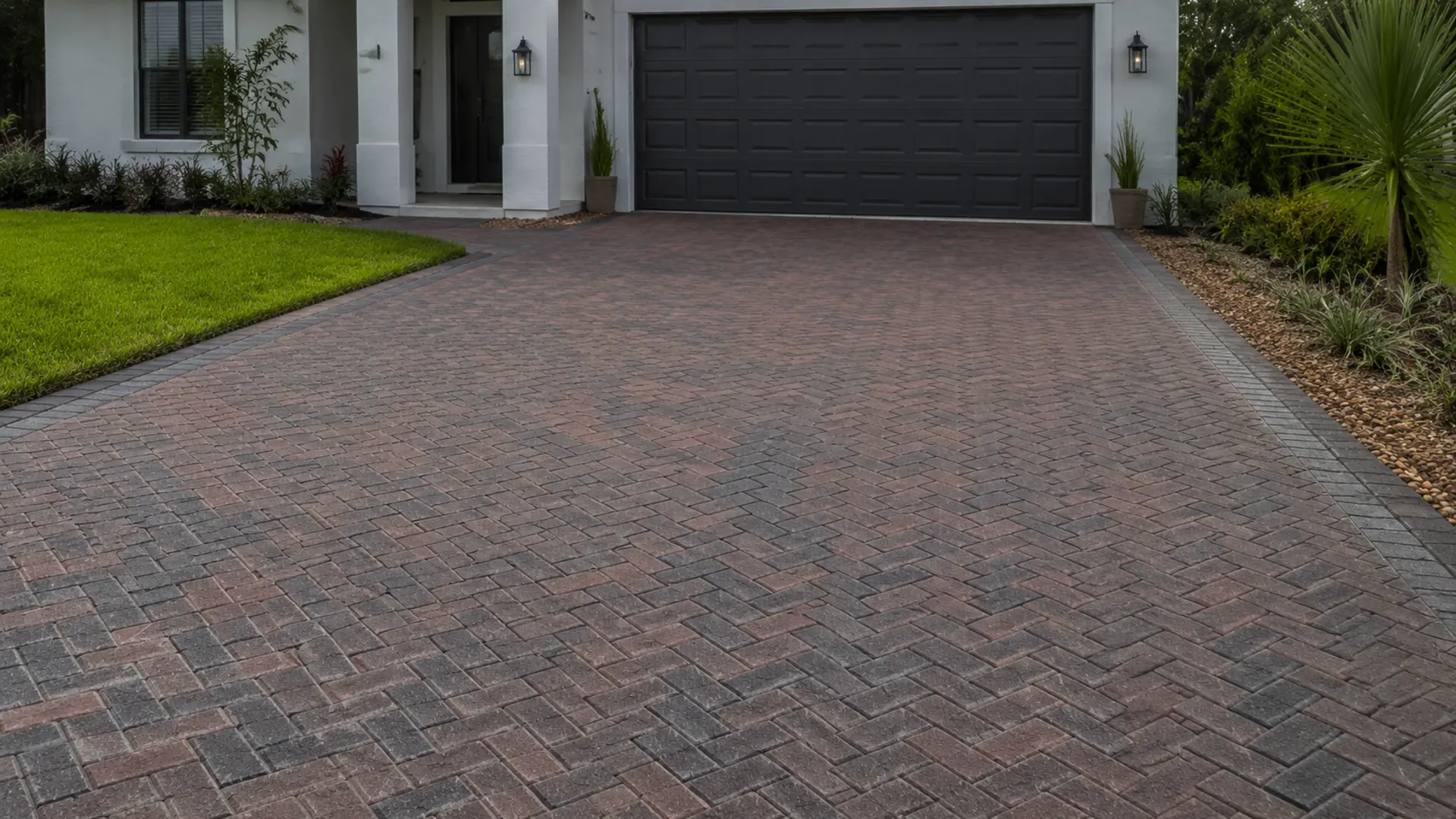
Lakeland Concrete Driveway Experts pour paver-pattern stamped concrete driveways for homeowners and commercial owners across Lakeland and Polk County. Our reputation rests on delivering every project we take on, using the best materials for the application, meeting or exceeding Florida Building Code, and specifying the pattern, colour and slab around your property rather than a catalogue.
The reason people choose this over real pavers here is practical: paver driveways lose joint sand to summer downpours, weeds and fire ants move into the gaps, and units settle unevenly over migrating sand. A monolithic stamped slab gives the same visual language with none of that. It is also work that cannot be templated, because a convincing result depends on layered colour and pattern alignment set out before the pour. We have laid herringbone at brick scale across double drives and large format on contemporary frontages. Below covers the patterns, how we make it read as real units, the maintenance you avoid and what it costs.
Paver pattern and unit scale should suit the width of the drive and the architecture behind it rather than the sample board. Herringbone at brick scale is the most convincing across a double drive, running bond reads calmer on a wide frontage, and large-format units suit the contemporary stucco homes going up around Davenport and Haines City.
Interlocking at forty-five or ninety degrees. The most convincing paver pattern at brick scale.
Straight courses with staggered joints. Calm and traditional across a wide frontage.
Paired units alternating direction. Reads period, and suits older or formal elevations.
Irregular rounded units with deeper joints, for a softer and older look.
Bigger rectangular units with tight joints, which suits contemporary stucco homes.
A perimeter run framing the field, exactly as a real paver drive would be laid.
This is where a convincing paver-pattern stamped driveway separates from an obvious one, and it is almost entirely colour work. Real pavers vary unit to unit, so a single flat tone across the pattern reads immediately as one piece of concrete pretending to be many. We build the colour in layers and hand-tone individual units on tighter patterns.
A base colour through the whole mix so nothing reads as grey concrete underneath.
Worked into the surface with deliberate variation rather than a single flat tone.
Settles into the joint impressions so grout lines read darker than the unit faces.
Individual units tinted slightly differently so no two neighbours are identical.
Impressions pressed to a consistent depth so the pattern reads crisp, not shallow.
Saw cuts run along a grout line so the structural cut disappears into the pattern.
This is the maintenance list a real paver driveway carries in Central Florida and a paver-pattern stamped slab does not. No joint sand to lose in a summer downpour, nothing for weeds or fire ants to colonise, no individual units settling unevenly over migrating sand, and no edge restraints to fail.
There is no sand in the joints to wash out in a storm, so nothing to top up.
Nothing can root between units, because there is nothing between units.
Sand joints are ideal nesting medium. A monolithic slab offers none.
The slab moves as one piece rather than settling unit by unit over sand.
Paver drives rely on edge restraints that eventually give; a slab does not.
Reseal every two to three years, and that is the whole maintenance list.
Both paver-pattern stamped concrete and real pavers have legitimate uses, and the comparison below is judged on how each behaves on Central Florida sand rather than in a showroom. It also concedes the one place real pavers still win, which is lifting out and swapping a single damaged unit.
| Paver-pattern stamped | Clay or concrete pavers | |
|---|---|---|
| Weeds in joints | None, no joints exist | Ongoing in sand joints |
| Fire ants | No nesting medium | Sand joints are ideal |
| Settling over time | Slab moves as one unit | Units settle independently |
| Joint sand after storms | Not applicable | Needs periodic re-sanding |
| Replacing one damaged area | Panel cut and repoured | Lift out and swap the unit |
| Spanning a soft spot | Reinforced slab bridges it | Each unit bears locally |
| Relative cost | Mid | Highest |
This is the slab under the pattern and how the pattern itself is set out. The detail worth noting is joint placement: control joints are saw cut directly along a grout line in the pattern, so the structural cut disappears into the design rather than running visibly across it.
Pattern alignment is fixed before any concrete arrives, because there is no adjusting it once the slab is placed. The origin point and angle are marked on the sub-base so courses run square to the garage door and the street edge rather than to the shape of the driveway, which is what stops the pattern looking accidental at the boundaries.
Starting point and angle marked so courses run square to the house and street.
Compacted limerock base, then the rebar grid tied and lifted on chairs.
The 4,000 PSI mix placed and floated, then colour hardener broadcast in two passes.
Antique release applied and mats pressed in sequence, keeping the courses registered.
Border and cut units hand-tooled where the pattern meets apron, garage and lawn.
Joints cut along grout lines, excess release rinsed after a day, then sealed.
Paver-pattern stamped driveway cost sits below a real paver installation and roughly alongside other stamped work, and the gap widens over ten years once you account for re-sanding and weed control. Here is where it wins, and the one place real pavers still beat it.
On price this sits below a real paver driveway and roughly alongside other stamped work, since the pattern is more intricate but the material is a single pour rather than thousands of individual units laid by hand. Over ten years the gap widens further in its favour, because the paver drive is absorbing re-sanding, weed control and occasional re-levelling that this one simply does not need.
Straight answers, including the ones that talk you out of spending money.
From the street, yes, provided the colour was built in layers rather than as one flat tone. Standing on it, someone who knows pavers will tell, because the grout lines are impressions rather than real gaps. Most people choose it knowing that and preferring it to the maintenance.
Sandy sub-grade and torrential summer rainfall. Water moving through the sand carries it away, so bedding layers erode unevenly and units settle at different rates. The same rainfall washes out joint sand, which then invites weeds and fire ants into the gaps.
A crack can be routed and filled along a grout line, where the pattern hides it far better than a plain finish would. If a panel has moved structurally, that panel is saw cut out, repoured, then stamped and coloured to match. More involved than swapping a paver, which is the real trade-off.
Only through a polymer overlay, and only if the slab underneath is genuinely sound. An overlay reproduces every crack and settled panel below within a couple of years. We assess the slab first rather than selling an overlay onto something already failing.
The slab has the same life as any correctly built driveway, twenty-five to thirty years and often more, and the pattern is permanent because it is pressed into the structure. What has a cycle is the sealer protecting the colour, which is a two to three year job here.
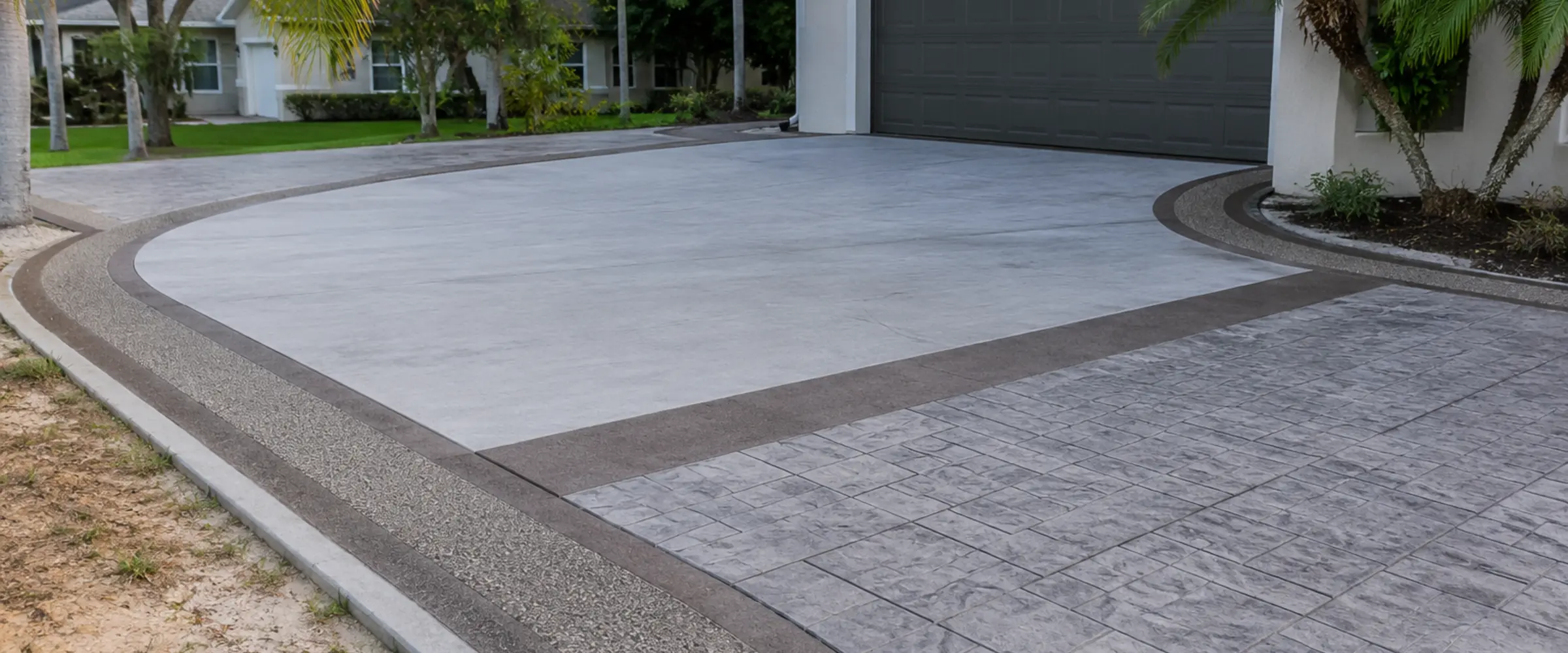
We will show you pattern and colour options on site, and price it against what a real paver drive would cost you over ten years.
863-734-6623