
Panels at Different Heights
A step between sections means the ground has moved, and patching will not stop it moving.
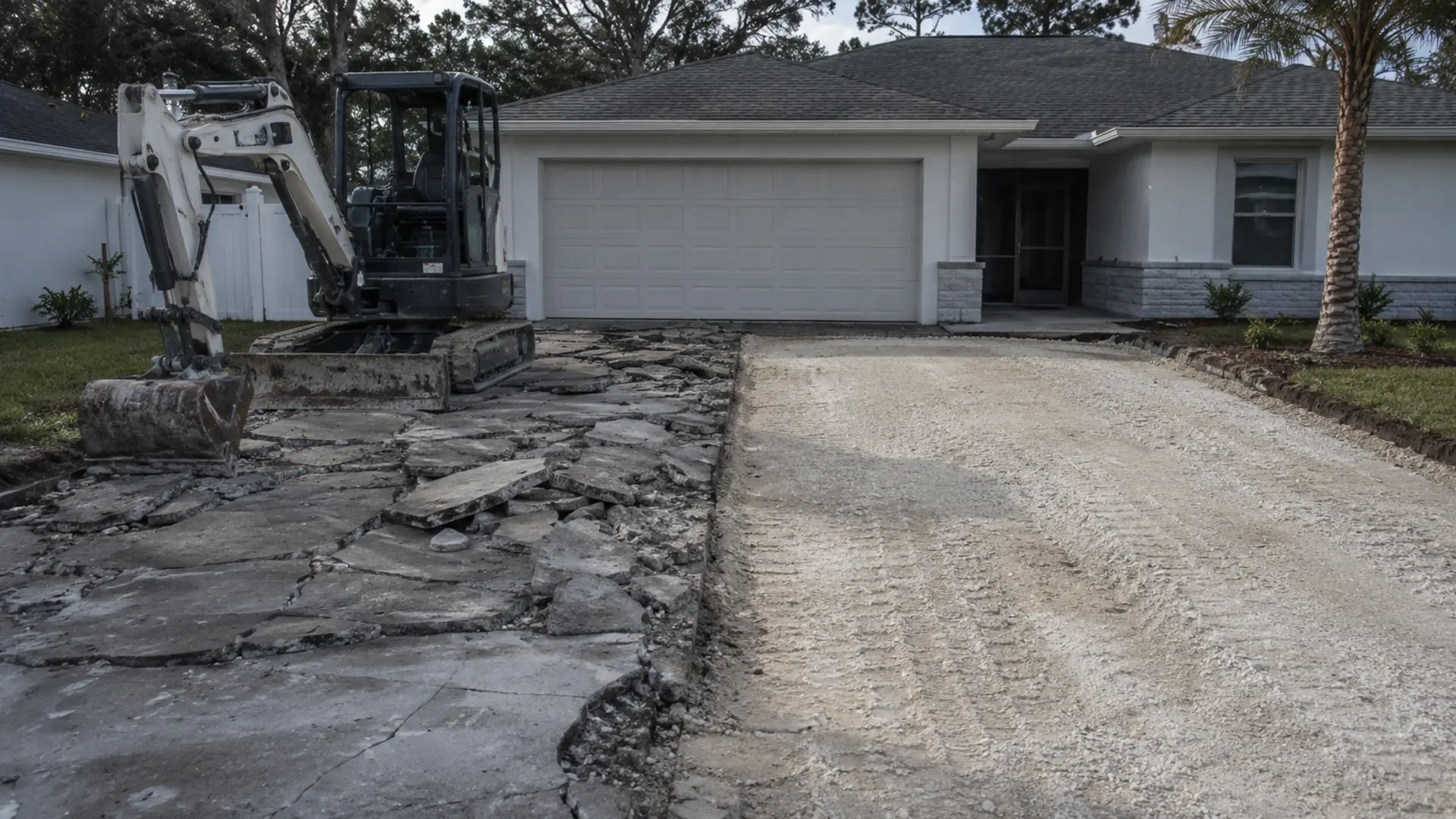
Lakeland Concrete Driveway Experts tear out and rebuild failed concrete driveways for homeowners, landlords and commercial owners across Lakeland and Polk County. We have earned our reputation here by delivering on every replacement we take on, using the right materials for the ground we actually find, building to meet or exceed Florida Building Code and local requirements, and writing the specification around your property rather than a template.
No two replacements are alike, which is why they cannot be quoted from a photograph. The value is never the new concrete itself, it is the one chance you will ever get to fix whatever destroyed the first slab, while the ground is open. We have rebuilt unreinforced 1960s driveways cracked down their length, slabs that dropped into consolidated organic pockets, and drives undermined for a decade by a downspout nobody moved. What follows covers when replacement is genuinely the right call, what happens to the old slab, the sub-grade work that makes the difference, and how it compares against resurfacing or lifting.
Repair, resurfacing and slab lifting are all cheaper than replacement, and on a sound slab they are frequently the better answer. The dividing line is whether the problem sits on the concrete or under it. Surface wear, staining and shallow flaking are surface problems. Movement is not.
These are the six conditions that tell us the sub-base has failed rather than the surface. Most are things you can check yourself with a straight edge and a walk down the drive, and if none of them apply we will say so and quote you the smaller job instead.
A step between sections means the ground has moved, and patching will not stop it moving.
If one side sits higher than the other, that is settlement rather than shrinkage.
A void beneath the slab. Concrete with nothing under it will break under a wheel.
Sand washing out from under the perimeter, usually visible as a lip along the lawn.
The fall has gone the wrong way, and only re-grading the whole slab fixes that.
Previous repairs cracking along the old lines means the cause was never addressed.
The replacements we carry out around Lakeland fall into a handful of recognisable types, and knowing which one you have tells us most of what the job needs before we open the ground.
A 1970s slab with no steel in it is a different exercise from a builder driveway that has dropped over a utility trench, and both are different again from a commercial approach breaking up under delivery traffic. Each one changes the excavation depth, the base specification and whether remediation is likely, which is why we survey rather than quoting from a photograph.
Poured thin with no steel and shallow joints, now cracking in several directions at once.
A section dropped where buried root mass or muck consolidated. The pocket comes out.
Ground disturbed for a service run and never compacted, settling for years afterwards.
Where a previous resurfacing was laid over a moving slab and reflected straight through.
Runoff that has quietly carried the sub-base out from under a long unsupported perimeter.
Slabs built to residential thickness that are now failing under delivery and refuse traffic.
Breaking the old driveway out is the visible half of a replacement. It is also where the schedule and a fair share of the cost sit, because a slab with a heavy wire mesh or a second slab poured underneath it takes roughly twice as long to break as a plain four-inch pour.
Everything we remove goes to a Polk County recycling facility, is crushed and screened, and comes back into the market as base aggregate, frequently the same material that goes under your new slab. Reinforcing steel is pulled and recycled separately as metal, so in practice nothing from a driveway demolition needs to reach landfill.
An excavator-mounted breaker fractures the slab, with water applied for dust control.
Old mesh and rebar are pulled and recycled as metal rather than going in with the rubble.
Broken concrete is crushed and screened locally and returns as reusable base rock.
A driveway poured over an older driveway is common and roughly doubles breaking time.
The municipal kerb is protected, since damaging it becomes your problem to fix.
The ground is inspected while exposed. This is the only moment it ever will be.
With the old slab gone, everything that destroyed it is visible and reachable. Soft spots, organic material, washed-out voids and the downspout that has been undermining the edge for a decade all get dealt with now, because pouring a new slab onto the same ground buys you a repeat of the same failure on a delay.
It is also the cheapest moment to change what the driveway actually does. Width, thickness for an RV, a turnaround, edge curbing, a drain at the garage threshold and a decorative finish all cost a fraction specified now against retrofitting them later, because the excavation, forms and concrete delivery are already paid for.
Dug out and replaced with clean compacted fill rather than compacted in place.
Downspouts, irrigation leaks and silted swales that undermined the old slab.
A 2 percent fall away from the structure, corrected where the original ran the wrong way.
Setback permitting, and far cheaper now than as a separate job later.
Six inches with heavier steel where a motorhome or trailer will sit on it.
A continuous curb and a channel drain, dealing with the cause rather than the symptom.
Three different answers to three different problems, and choosing the wrong one is expensive twice. An overlay on a moving slab reflects the same crack through within about two years, and lifting a fractured panel just moves the pieces independently.
| Full replacement | Resurfacing | Slab lifting | |
|---|---|---|---|
| Fixes the ground underneath | Yes | No | Fills voids only |
| Works on a cracked slab | Yes | Only stable cracks | No |
| Works on a settled slab | Yes | No | Yes |
| Changes the appearance | Completely | Completely | Not at all |
| Time without the driveway | About 10 days | About 4 days | Same day |
| Relative cost | Highest | Mid | Lowest |
What the new slab is built to, and the figures worth putting in front of any competing quote.
Three to four days on site, then seven before you park on it, so plan on roughly ten days without the drive. Where the layout allows we can stage the work in halves to keep part of it usable.
We work out why the old slab failed, because that determines the remedial work.
Application submitted and 811 marks utilities before anything is broken out.
Slab broken, steel separated, material carted to a recycling facility.
Soft and washed-out areas dug out and rebuilt with compacted fill.
New limerock base compacted and graded, forms set, rebar tied on chairs.
New slab placed and finished, joints cut within a day, seven day wet cure.
Two quotes for the same tear-out can differ substantially, and it is usually one of these.
The biggest single variable is what sits under the old slab, and nobody can see it until the concrete comes off. A driveway over clean Apopka or Millhopper sand needs a standard base; one over an organic pocket needs that material excavated and imported fill brought in. The second is the old slab itself, a plain four-inch pour breaks out quickly, while heavy wire mesh, or a second slab underneath, roughly doubles the breaking time.
Straight answers, including the ones that talk you out of spending money.
The rough test is whether the problem is on the concrete or under it. Surface wear, staining and shallow flaking can be resurfaced. Panels at different heights, cracks with a lip, or a hollow sound underfoot mean the ground has failed, and no surface treatment holds that still.
Three to four days of work and then seven days of curing before you can park on it, so about ten days in total. Depending on the layout we can sometimes stage it so part of the drive stays usable.
It goes to a Polk County recycling facility, is crushed and screened, and comes back as base aggregate. Reinforcing steel is separated and recycled as metal. Nothing needs to go to landfill.
That is the main reason to replace rather than patch. With the slab off we can see the sub-grade directly and rebuild the soft or washed-out areas. Pouring onto the same ground would give you the same failure again on a delay.
Yes, and this is when it is cheapest. Widening, a thicker section for an RV, a turnaround, edge curbing and decorative finishes all cost far less specified now than retrofitted later.
We will look at it first and tell you honestly whether a repair, a lift or a resurfacing would do the job for less.
863-734-6623