
Swirl Float
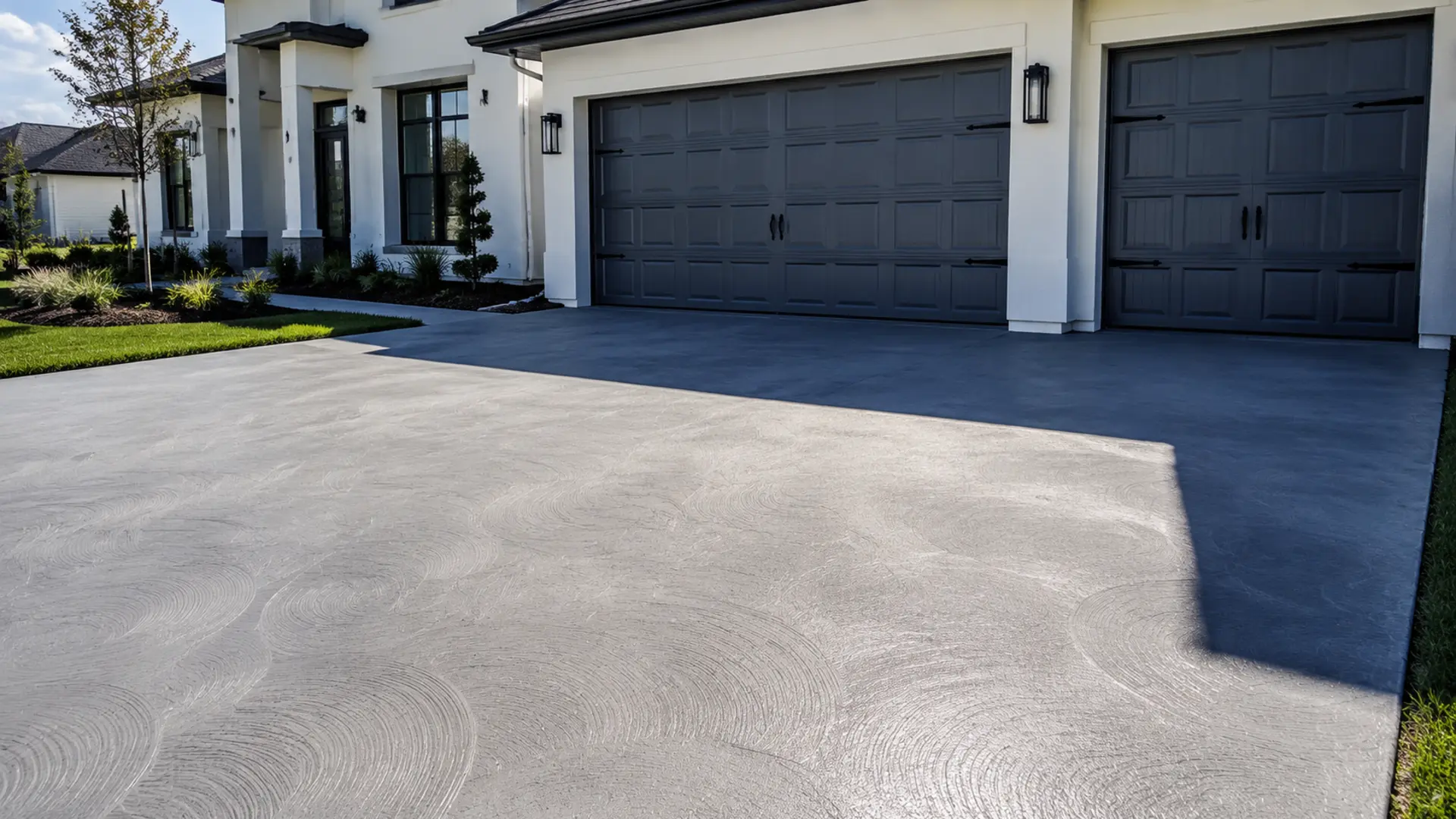
Overlapping arcs worked with a fresno. The most common, and forgiving over a large area.
Lakeland Concrete Driveway Experts pour hand-textured concrete driveways for homeowners across Lakeland and Polk County. We have earned our reputation by delivering on every project we take on, using the best materials for the application, meeting or exceeding Florida Building Code, and specifying around the property and the Central Florida conditions rather than a standard package.
Textured concrete sits between a plain broom finish and full stamped work, and it is the least reproducible thing we do because the surface is worked by hand in a two to four hour window. Depth and consistency come down to how hard each pass is pressed, so one person runs the field. We have swirl-floated wide modern frontages, laid slate-skin texture that reads as fine stone with no joint lines, and matched hand texture into replaced panels on driveways we did not originally pour. Below covers the finishes we hand-work, why people choose texture over stamping, getting it right on the day and how it ages.
These textured concrete finishes are all worked by hand in the same short window after the pour, and all of them can carry integral colour. Swirl float is the most forgiving across a large area, slate skin gives fine stone grain with no joint lines at all, and a troweled border frames the field without a change of material.
Overlapping arcs worked with a fresno. The most common, and forgiving over a large area.
Larger sweeping arcs in a deliberate repeating rhythm rather than a random overlap.
A flexible texture skin pressed in to impress fine stone grain with no joint lines at all.
A smooth banded edge around a textured field, defining the drive without a material change.
Straight or curved combing, coarser than a broom, giving directional grip on an incline.
Areas worked to different sheens so light moves across the slab through the day.
People choose a textured concrete driveway over stamping for reasons that are not usually about money. It does not imitate anything, so it suits contemporary and minimal elevations. There are no grout lines for sand, algae or oak debris to settle into. And because there is no pattern to register, a future repair can be hand-matched into the field.
No fake stone or brick, which suits contemporary and minimal elevations.
Nothing for sand, algae or oak debris to settle into and darken over time.
No pattern to register, so a routed crack or new panel can be hand-matched.
No antiquing release to protect, so a penetrating sealer will do the job.
No mats, colour hardener or release, and no crew racing a stamping window.
Real light and shadow across the surface, which a flat broom finish does not give you.
A hand-textured concrete finish is craft work inside a two to four hour window, and that shapes how the whole job is run. Texture depth depends on how hard each pass is worked, so one person runs the field for consistency, and nothing is touched until bleed water has evaporated.
Nothing is worked until bleed water has evaporated. Working over it causes dusting later.
Large areas are broken into sections with a planned sequence, not stretched thin.
Texture depth depends on how hard each pass is worked, so one person runs the field.
Any troweled border is finished after the field so it stays crisp against the texture.
Light-catching surfaces exaggerate any dish or hump, so the base is laser-checked.
Control joints placed so they read as part of the layout rather than across it.
This is what sits under the hand finish on a textured concrete driveway. Worth noting: a light-catching surface exaggerates any dish or hump in the slab, so the sub-grade is laser-checked before forms are set rather than corrected at the screed.
On a textured concrete driveway everything decorative happens in the two to four hours after the pour. The slab is placed and floated flat, then left until bleed water clears before any texture is worked in, finishing over bleed water is the root cause of surfaces that dust for years afterwards.
Concrete placed to the forms and screeded to a two percent fall away from the house.
Floated flat, then left until bleed water has gone. This step cannot be rushed.
Edges tooled and joint lines marked so texture can be worked cleanly up to them.
Swirl, arc or skin texture applied section by section, working back toward the access point.
Any troweled band finished last so it stays sharp against the textured field.
Control joints saw cut within twenty-four hours, then a seven day wet cure.
Textured concrete driveway cost sits above a broom finish and below stamped work, because it is skilled labour in a short window rather than materials. Here is what to expect from it over the next fifteen years, including how the relief wears in the tyre paths.
Textured work costs above a broom finish and below stamped, because it is skilled labour in a short window rather than materials. There is no colour hardener, no release agent and no mat hire, so most of the difference is time on site. A penetrating matte sealer is the usual specification, which resists oil and slows algae on shaded drives without committing you to a two to three year coating cycle.
Straight answers, including the ones that talk you out of spending money.
Stamped uses rigid mats to press an imitation stone pattern into the slab, complete with grout lines. Textured work is hand finishing that adds surface relief and light play with no joint pattern. It costs less, has no antiquing release to maintain, and repairs blend in far more easily.
A penetrating silane or siloxane is worth it, mainly for oil resistance and to slow algae on shaded drives. There is no pigment layer to protect, so the sealer is doing a purely functional job and a matte penetrating product is the right choice.
It smooths slightly over many years in the wheel paths, especially where cars turn on the same spot. It is a gradual and even change rather than a failure, and integral colour makes any smoothing much less noticeable.
More easily than any other decorative finish. There is no pattern to line up, so a routed crack or a replaced panel can be re-textured by hand to blend into the field. Colour is the only real matching challenge, and that applies to any concrete repair.
Less than a smooth troweled surface and less than sealed stamped concrete, because the shallow relief grips in every direction. On a steep or heavily shaded drive we specify a matte penetrating sealer rather than a film, which keeps traction close to bare concrete.
Textured concrete gives you real character without the maintenance cycle. We will show you swirl, arc and slate skin samples.
863-734-6623