
Herringbone
Interlocks at 45 or 90 degrees. The strongest pattern under vehicle traffic and turning.
Lakeland Concrete Driveway Experts install and replace interlocking paver driveways for homeowners and commercial owners across Lakeland and Polk County. Our reputation rests on delivering every project we take on, using the best materials for the application, meeting or exceeding Florida Building Code, and building the base to a standard that survives Central Florida sand and rainfall.
Pavers give architectural detail a monolithic slab cannot: individual units, real colour variation, and a look that suits lakefront residences and custom estate frontages. They are also the surface most often installed badly here, because on fast-draining sand the base is everything and the base is invisible once the units are down. We excavate deeper than most, lay geotextile separation fabric, compact a crushed aggregate base in lifts and finish with polymeric joints. Below covers the styles and patterns, how the base is built, what Florida does to a paver driveway and how it compares to a poured slab.
Unit shape and laying pattern change both the appearance and the structural performance. Interlocking patterns distribute wheel load across neighbouring units; running bond does not, which matters more on a driveway than on a patio.
Interlocks at 45 or 90 degrees. The strongest pattern under vehicle traffic and turning.
Straight courses with staggered joints. Calmer visually, weaker under turning load.
Paired units alternating direction, suiting period and formal frontages.
Rounded and distressed units reading older, softer and less uniform.
Bigger units with tight joints, suiting contemporary stucco elevations.
A perimeter run framing the field and restraining the edge units.
Nearly every failed paver driveway we are called to failed underneath rather than on top. The units themselves rarely break; they settle, rut and spread because the base was too thin, was never compacted in lifts, or had no separation fabric between aggregate and native sand.
8 to 10 in below finished level, removing topsoil and organics entirely.
Woven separation fabric stopping aggregate migrating down into the native sand.
6 in of crushed aggregate placed in lifts and compacted, not tipped and levelled.
1 in of washed concrete sand, screeded flat and never used to correct base falls.
A concrete haunch or spiked restraint, without which the field spreads and joints open.
Swept in and activated after compaction, binding the joints against washout.
Pavers are a jointed system, and joints are exactly what Central Florida attacks. Understanding this before you choose the surface is the difference between a driveway you enjoy and one that becomes a maintenance schedule.
Torrential summer rainfall lifts unbound sand out of joints, which is why we use polymeric.
Any depleted joint becomes a seed bed. Full joints are the actual weed control.
Sand joints are ideal nesting medium, and colonies undermine bedding as they expand.
Units settle independently over migrating sand, producing a wavy surface.
Once the restraint gives, perimeter units rotate outward and joints open across the field.
Live oak roots lift individual pavers readily, though single units can be reset.
We install all three, so this is a straight comparison rather than a pitch. The honest summary is that pavers buy you genuine unit-by-unit repairability and pay for it in joint maintenance.
| Interlocking pavers | Poured concrete | Paver-pattern stamped | |
|---|---|---|---|
| Appearance | Real individual units | Monolithic surface | Imitates units convincingly |
| Joints | Real, need re-sanding | None | Impressions only, nothing to fill |
| Weeds and fire ants | Ongoing management | None | None |
| Settlement | Units move independently | Slab moves as one | Slab moves as one |
| Repairing one area | Lift and swap units | Cut and repour a panel | Cut, repour, restamp and recolour |
| Maintenance | Re-sanding, sealing, weeding | Low | Reseal every 2 to 3 years |
| Relative cost | Highest | Mid | Mid |
The build standard behind every paver driveway we lay. Base depth, compaction and edge restraint are the three that decide whether the surface is still flat in fifteen years.
Three to four days on site for a standard residential drive, and usable immediately once the joints are activated. Almost all of the work happens below the units.
Levels shot, falls confirmed, and the laying pattern and border set out to the frontage.
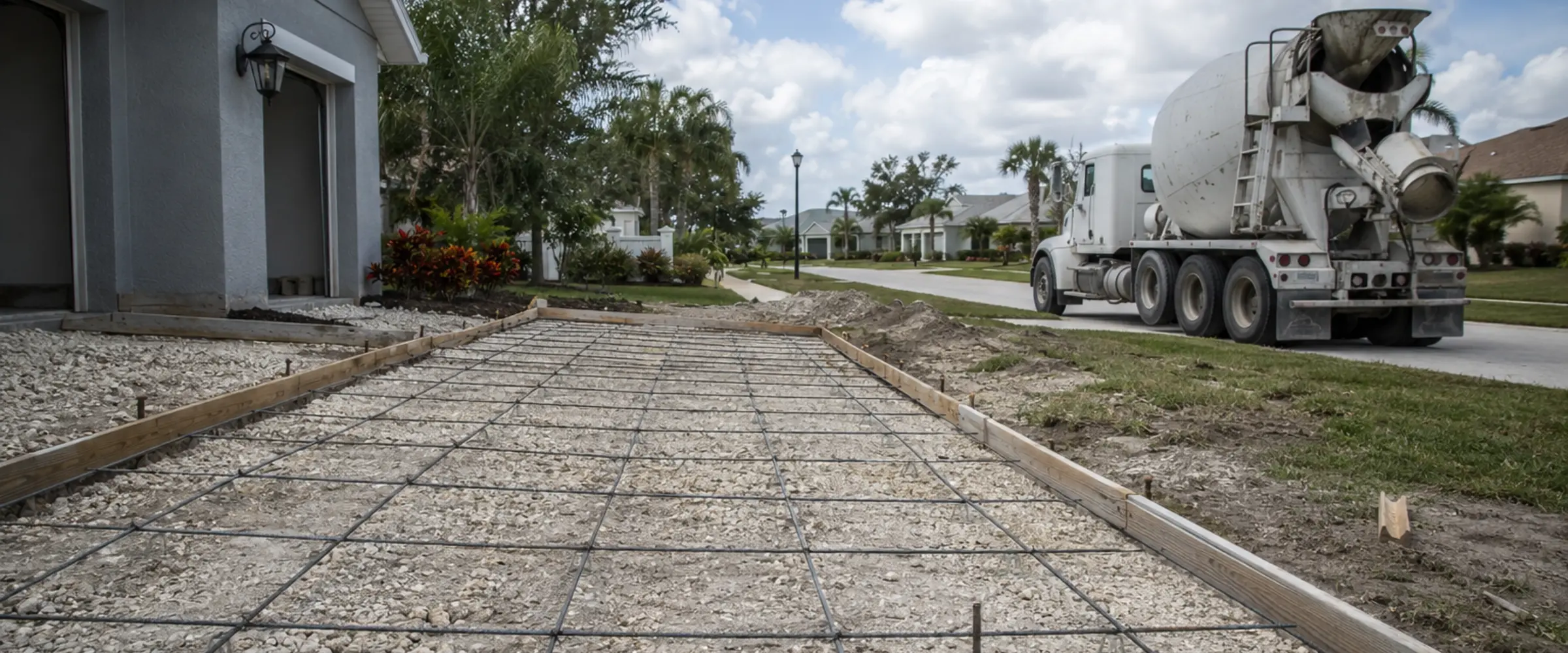
Cut 8 to 10 in below finished level, removing topsoil, organics and soft material.
Geotextile laid, then crushed aggregate placed in lifts and compacted to density.
1 in of washed sand screeded flat, with edge restraint set to the perimeter line.
Units laid to pattern from a fixed baseline, with border cuts made on a wet saw.
Plate compacted through a protective mat, then polymeric sand swept in and activated.
The honest position on price and upkeep, from a contractor who installs the alternatives too.
Pavers are the highest up-front cost of the three driveway surfaces we lay, because the excavation is deeper, the base is thicker and the units are set individually by hand. What you buy for that is genuine repairability: a stained or cracked unit lifts out and a replacement drops in, and nobody can tell. What you sign up for is joint maintenance, because Central Florida rainfall works on joints continuously and depleted joints invite weeds and fire ants. If that maintenance appeals, pavers are excellent. If it does not, paver-pattern stamped concrete gives the same visual language with nothing to re-sand.
Straight answers, including the ones that talk you out of spending money.
Twenty to twenty-five years for the units themselves, which outlast the base beneath them. What determines the real service life is base depth and compaction, plus keeping the joints full. The pavers rarely fail; the bedding and joints do.
They do when the base was too thin, was not compacted in lifts, or had no separation fabric over the native sand. Built properly, with a compacted six-inch aggregate base and a proper edge restraint, movement is minimal. Individual units that do settle can be lifted and reset.
Keep the joints full. Weeds germinate in depleted joint sand, so polymeric sand binds the joints and resists washout far better than plain sand. Expect to top up every three to five years depending on how exposed the driveway is to concentrated runoff.
Yes, with the right specification. Use 60 mm minimum driveway-grade units in a herringbone pattern, over a deeper compacted base. Herringbone matters because it interlocks and shares load between neighbouring units, which running bond does not. Patio-grade pavers will crack under a vehicle.
It depends on your appetite for maintenance. Stamped concrete gives the same look with no joint sand to wash out, nothing for weeds or fire ants, and a slab that moves as one. Pavers give real units and single-unit repairs. We install both and will lay out the trade-off honestly.
We will show you patterns and unit options, and price it honestly against poured and stamped concrete for the same area.
863-734-6623