
A Step Between Panels
One section has settled as a unit, leaving a trip edge at the joint with its neighbour.
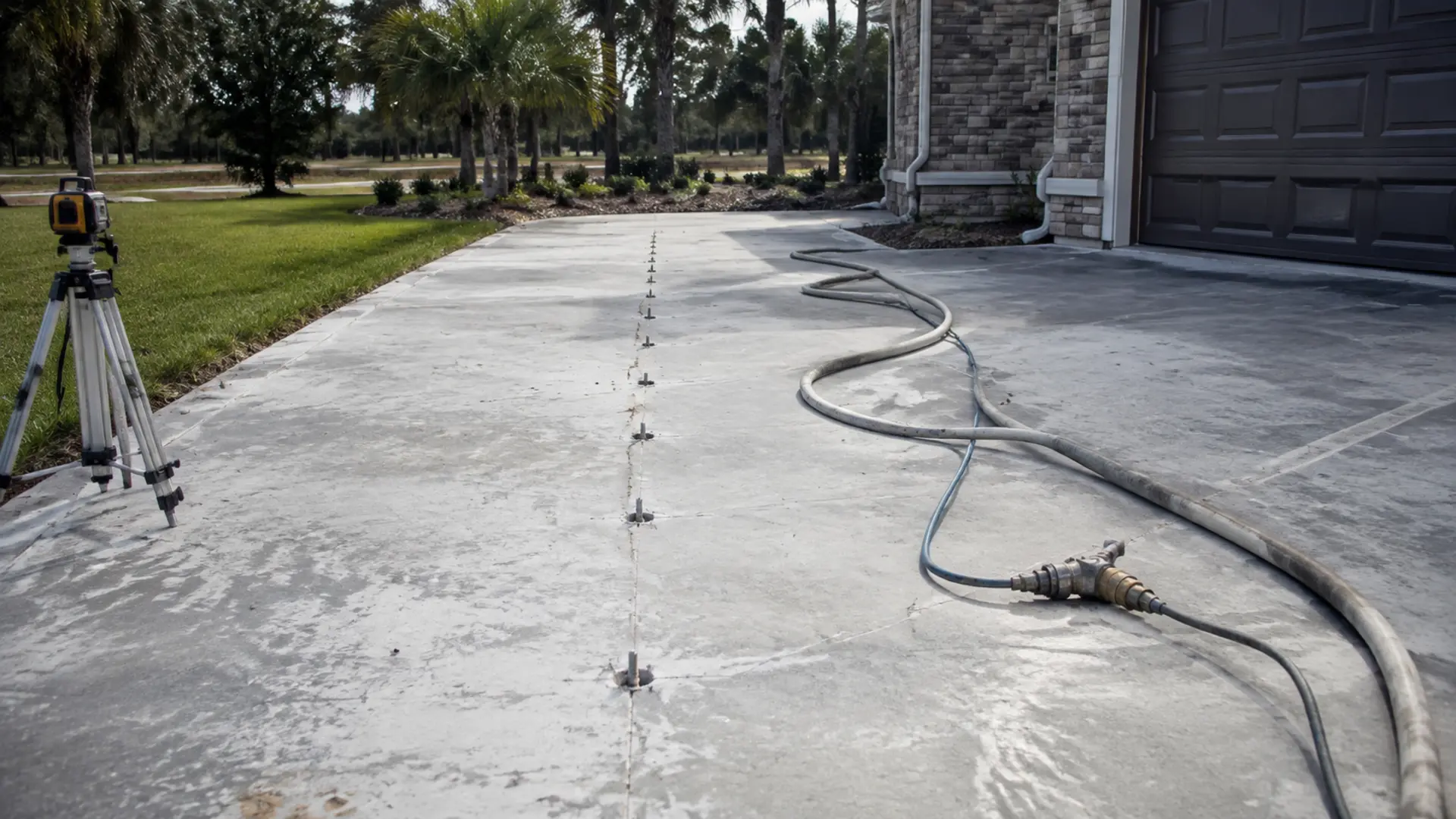
Lakeland Concrete Driveway Experts lift settled concrete driveway slabs back to grade for homeowners and commercial owners across Lakeland and Polk County. We have built our reputation on delivering every job we take on, using the right injection system for the ground underneath, working to meet or exceed code and manufacturer requirements, and specifying around your property rather than a template.
A sunken driveway panel is almost never a concrete problem, the slab is usually fine and the ground beneath it has gone. That makes every lift different, because the void has a cause and the cause decides how long the fix holds. We have raised panels that dropped into consolidated organic pockets, aprons settled over old utility trenches, and slabs quietly undermined for years by a downspout discharging at the edge. What follows covers when lifting is the right fix, foam against traditional mudjacking, what caused your slab to drop, and how it compares to replacing the panel.
Concrete driveway slab lifting works on sound slabs that have dropped as a unit. It does not work on broken ones, because lifting a fractured panel simply moves the pieces independently. These are the situations where it is the right fix, and the one where it is not.
One section has settled as a unit, leaving a trip edge at the joint with its neighbour.
The driveway has pulled away and dropped at the threshold, so water now runs inward.
A dropped tool or a heel makes a hollow note, meaning there is a void beneath.
An area that used to drain now holds water after every storm.
Common where backfill over a utility trench has consolidated over the years.
Not a lifting job. Fragments will move independently and need replacing instead.
Polyurethane foam injection and traditional cement-slurry mudjacking both raise a settled driveway slab, but they suit different ground and different budgets. Foam is light, cures to load in about fifteen minutes and leaves ports you can barely find. Slurry is cheaper and heavier, which can be exactly the wrong property over soft organic ground.
Five eighths of an inch, patched flush and difficult to find afterwards.
Very light, so it adds almost nothing to ground that has already proven it cannot carry load.
Load-bearing in about fifteen minutes, so the driveway is back in service the same day.
One to one and five eighths inches, noticeably more visible in the finished slab.
Cement slurry is heavy, which can be the wrong answer over soft organic ground.
Twenty-four to forty-eight hours before the slab takes traffic again.
Finding out what caused your driveway slab to drop is what stops it happening again, and it is the part most lifting quotes skip entirely. Filling the void fixes today; a downspout still discharging at the slab edge or a leaking irrigation line means you will be back here in a few years having paid twice.
Concentrated roof water washing sub-base out from under the perimeter, storm after storm.
A slow leak under a driveway moves a surprising volume of sand over a few years.
Buried root mass or muck that has rotted down and left a cavity behind it.
Ground disturbed for a service run and never compacted properly settles over time.
The base was never brought to density, so traffic has done the compacting since.
Runoff with nowhere to go finds a path under the slab instead of around it.
There are two ways to deal with a dropped driveway panel, and the choice turns on whether the concrete itself is still sound. Lifting keeps your original slab and its original colour and has you driving on it the same day. Replacement rebuilds the ground completely but leaves a panel that will read lighter for years.
| Slab lifting | Panel replacement | |
|---|---|---|
| Works on an intact slab | Yes | Yes |
| Works on a broken slab | No | Yes |
| Colour matches the rest | Perfectly, it is the original slab | No, new concrete cures lighter |
| Fixes the ground beneath | Fills the void | Rebuilds it completely |
| Back in service | Same day | Seven days |
| Relative cost | Roughly half to two thirds | Higher |
This is how a concrete driveway slab lift is carried out and, more importantly, controlled. Lift is brought up gradually across the whole panel while height is monitored on a laser, because raising a slab too quickly at a single port is how a sound panel gets cracked during the repair itself.
Most residential concrete driveway slab lifts are finished in a few hours and back in service the same afternoon. The sequence below includes the step that matters most and takes the longest, establishing what caused the settlement before anything is injected.
We establish how far it has dropped and confirm the panel is sound enough to lift.
Downspouts, irrigation and drainage are checked, because that decides how long the fix holds.
A grid of small ports through the slab, spaced to spread the lift evenly.
Material injected while slab height is watched on a laser, raised gradually across the panel.
Injection continues until the cavity beneath is full, so the slab sits on support not on points.
Ports filled flush with colour-matched mortar and the surrounding joints re-sealed.
What concrete driveway slab lifting costs, compared honestly against tearing out and repouring the same area. Lifting typically runs at roughly half to two thirds of replacement, keeps your original colour and has the driveway usable the same day rather than after a week of curing.
Lifting typically runs at roughly half to two thirds the cost of tearing out and repouring the same area, and the driveway is usable the same day rather than after a week of curing. The colour also matches perfectly, because it is your original slab back at the right height rather than a new panel that will read lighter for years. For a sound panel that has simply dropped, it is very difficult to beat on value.
Straight answers, including the ones that talk you out of spending money.
Usually about half to two thirds the cost of tearing out and repouring the same area, and the driveway is back in use the same day. Where it is not the right answer is when the slab is broken into several pieces, since lifting fractured concrete just moves the pieces independently.
Indefinitely, if the void was properly filled and the cause was dealt with. Where water is still washing material out from under the slab it can settle again, which is why we look for the source rather than only injecting.
Polyurethane ports are five eighths of an inch and patched flush with colour-matched mortar, so on a broom finish they are genuinely hard to find. Traditional mudjacking ports are much larger, which is one reason foam has largely replaced it on residential work.
Sometimes. A clean single break with both pieces sound can be lifted together and the crack then routed and sealed. A panel broken into several pieces or crumbling will not give a good result and is better replaced.
If the pooling is caused by a settled area, yes, because raising it restores the fall. If the driveway was built without adequate cross-slope in the first place, lifting improves it but cannot always create a full two percent fall.
Lifting is usually a few hours and a fraction of replacement. We will tell you if your slab is a candidate.
863-734-6623