
Class-A Motorhome Pads
Full-length pads at six inches, sized for slide-outs, awnings and walking room.
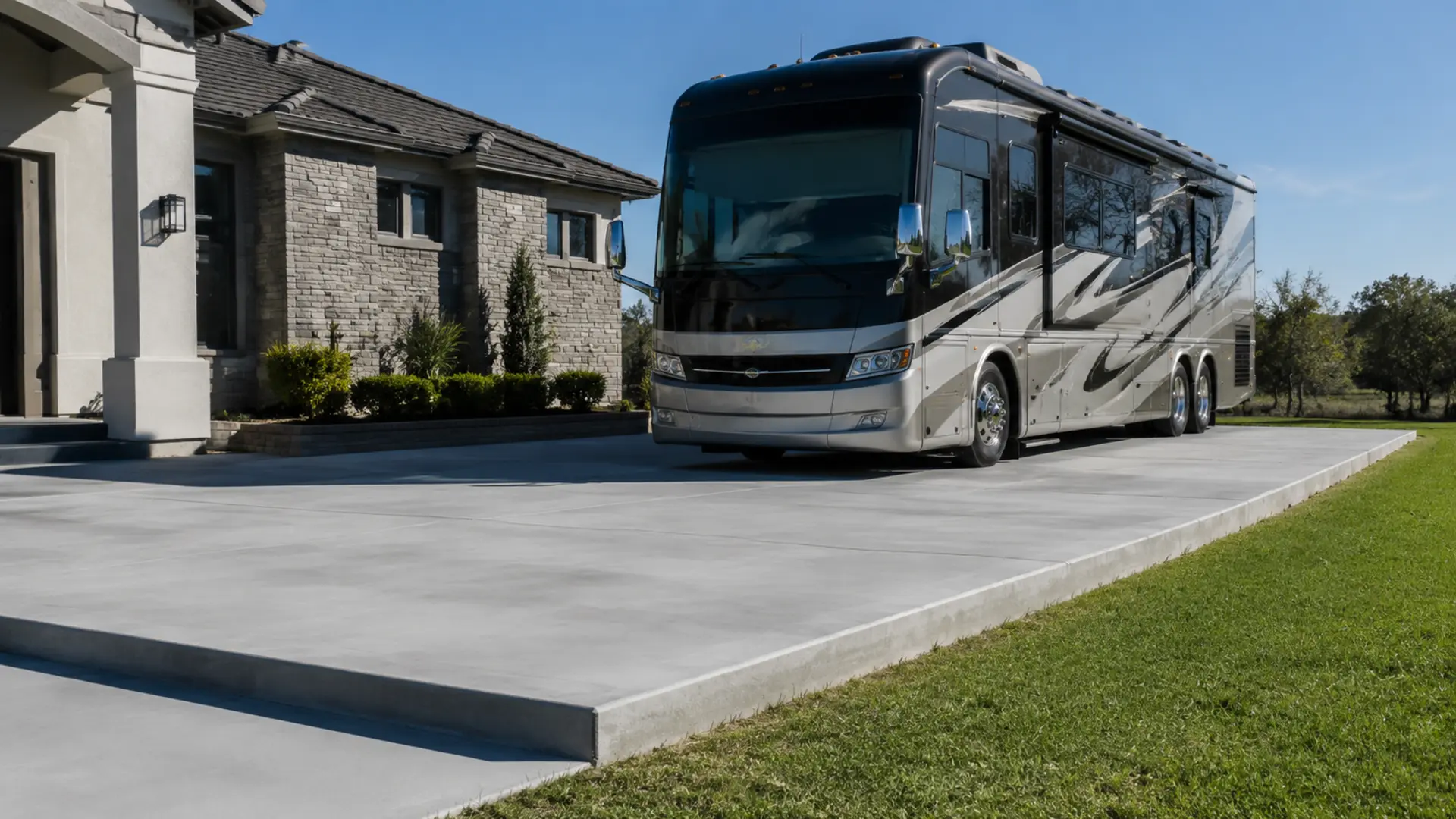
Lakeland Concrete Driveway Experts build heavy-duty RV and boat concrete pads for property owners across Lakeland and Polk County. We have built our reputation on delivering every project we take on, using the best materials for the load in question, meeting or exceeding Florida Building Code, and engineering each pad around the actual vehicle and the ground beneath it.
An RV pad is a different structure from a thicker driveway, and it cannot be sized from a table. A Class-A can exceed thirty thousand pounds and a loaded trailer concentrates much of its weight onto a jack foot, so slide-out reach, jack positions and the turning circle of the approach all feed into the design. We have poured pads for forty-foot motorhomes with slide-outs both sides, boat and trailer standing on rural lots, and equipment pads where machinery had been sitting on grass. Below covers the pads we build, why every element steps up, sizing and positioning, and the bearing capacity constraint underneath it all.
These are the RV and boat concrete pads we build, and every one is sized around the actual vehicle rather than a standard slab. A forty-foot Class-A with slide-outs both sides needs a genuinely different footprint from a thirty-two foot travel trailer, and the difference is not just length.
Full-length pads at six inches, sized for slide-outs, awnings and walking room.
Shorter footprint, with local thickening where the tongue jack concentrates load.
Sized to trailer length with the tow vehicle in mind, plus room to manoeuvre.
For tractors, mowers and trailers on the rural lots around Kathleen and Polk City.
Poured monolithically with the driveway so there is no cold joint between them.
Where a carport or RV cover is going up, with anchor positions set at pour time.
Every element of an RV pad steps up from a driveway specification, and each change has a reason you can point at. Higher strength mix for concentrated jack loads, greater depth to spread them, heavier steel at tighter centres, and thickened edges where the unit drives on and off, which is where under-specified pads break first.
Higher compressive strength for concentrated point loads from jacks and tandem axles.
Spreads load across a wider area of base, reducing bearing pressure on the ground.
Heavier steel at tighter spacing to carry the tensile stress a point load creates.
Pad edges take the highest concentrated load as the unit drives on and off.
Twice a driveway base, because the load being spread is several times greater.
Extra depth exactly where stabilisers land, rather than thickening the whole pad.
Sizing and positioning an RV or boat concrete pad is measured from your unit and your lot rather than a table. Slide-out reach, awning extension, walking room, jack positions and the turning circle of the approach all feed into it, alongside setback and lot coverage limits.
Length, width, slide-out extension and awning reach, taken from the specification sheet.
Space to walk both sides and open bays without stepping onto grass or mud.
One to two percent. RVs level on their jacks, and steep fall uses up jack travel.
The route from the street has to take the turning circle of the unit, not just the car.
Pads are typically 400 to 600 sq ft, so setback and lot coverage limits both apply.
Local rules on where a recreational vehicle may be stored, and HOA approval separately.
This is the heavy-duty build standard for an RV and boat concrete pad. The figure worth noting is cross-slope, kept deliberately gentle at one to two percent, an RV levels on its jacks, and a steep fall uses up jack travel before the unit is level.
Building an RV or boat concrete pad means more thorough base work than a driveway, because the load being spread into the ground is several times greater. Excavation goes deeper and any organic or clay pocket is removed entirely rather than compacted in place.
Specification sheet, slide-out reach and jack positions all taken into account.
Pad footprint checked against setback, lot coverage, storage rules and HOA.
Dug out further than a driveway, with any organic or clay pocket removed entirely.
Limerock placed in lifts and compacted to density, tested rather than assumed.
#4 rebar on twelve-inch centres, chaired, with edges formed to eight inches.
Placed and finished, then twenty-eight days before the unit goes on it.
Bearing capacity is the real constraint on an RV pad, and it is not the concrete. A thicker slab spreads load, but only into whatever is underneath it. Over a Bone Valley clay pocket or organic muck a heavy pad will settle regardless of how much steel is in the mix.
A thicker slab spreads load, but it can only spread it into whatever is underneath. On properly compacted Apopka and Millhopper sands that is generally good ground. Toward Mulberry, Bartow and parts of south Lakeland, Bone Valley clay pockets and organic muck have genuinely low bearing capacity, and a heavy pad over that will settle regardless of how much steel is in the concrete. That is why our base work here is more thorough than on a driveway and why we excavate and look rather than assuming.
Straight answers, including the ones that talk you out of spending money.
Six inches with a #4 rebar grid on twelve-inch centres, over six inches of compacted limerock. Four inches is a driveway specification and it is not adequate for a motorhome. Concentrated loads from stabiliser jacks and tandem axles are what break under-specified pads, usually at the edges first.
Measure the unit and add working room. A forty-foot Class-A typically wants twelve to fourteen feet wide and around forty-five long, allowing for slide-outs both sides and space to walk around. Bring the specification sheet and we will size it to your vehicle rather than an average.
You can, and many do, but a four-inch residential slab was not built for it. What follows is cracking under the jack positions and along the edge where the unit drives on. If the RV lives there rather than visiting occasionally, a purpose-built pad is cheaper over any reasonable timeframe.
Twenty-eight days, when the concrete reaches design strength. Light vehicles can use it at seven, but a motorhome should not, because the slab has not developed the strength the specification assumes. It is the most important instruction on this job.
Almost certainly. These pads are typically four hundred to six hundred square feet, which puts them well into permitted territory. Setback rules, lot coverage limits and local restrictions on recreational vehicle storage all apply, and HOA approval is separate.
Bring us the specification sheet for your unit and we will size and price a pad built to carry it properly.
863-734-6623