
Ashlar Cut Slate
Rectangular stone in a random layout. The most forgiving pattern across a wide, open driveway.
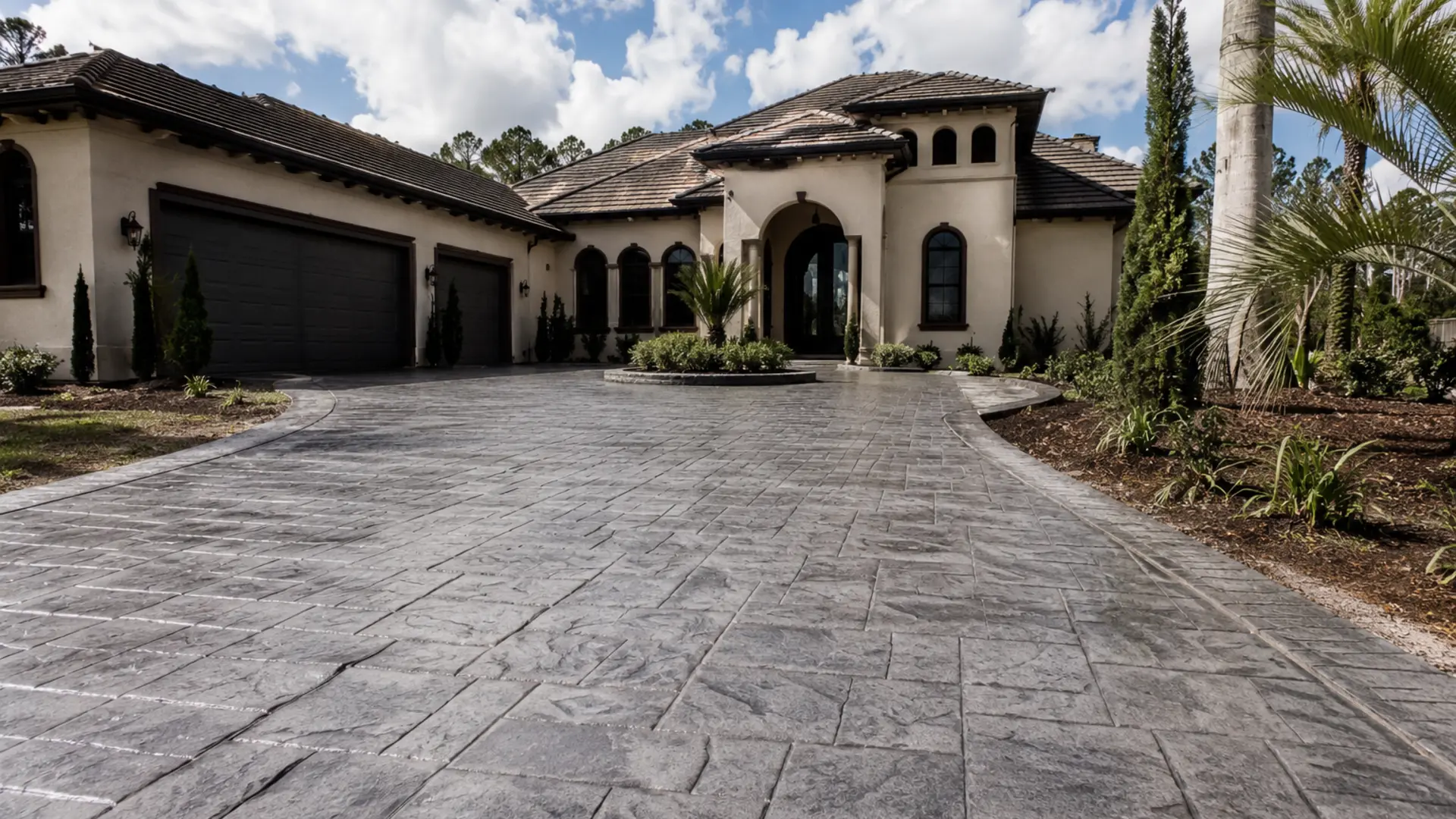
If you want the look of cut stone, brick or cobblestone on your driveway without any of the trouble that comes with real pavers, stamped concrete is the way to get it. Lakeland Concrete Driveway Experts have been stamping decorative driveways, entry courts and aprons for homeowners and businesses across Lakeland and Polk County for years, and it is the finish we get asked for most on the newer stucco homes going up around Davenport, Haines City and Lakeland Highlands.
You choose the pattern and the colour, and we build a scheme around the stone veneer, roof tile or brick already on your house rather than handing you a card and hoping something matches. What separates a stamped driveway that still looks sharp in ten years from one that goes flat is the timing on the day and the sealer afterwards. Stamping has to happen inside a short window while the concrete is workable, so we crew the job properly rather than stretching it, and in this sun the sealer wants a re-coat every couple of years, which we will remind you about and can come back and do.
Pattern scale should suit the house and the width of the drive rather than the sample board. Large-format ashlar reads well across a double drive; tighter cobble suits narrow lots and curved approaches. We have stamped everything here from single-car drives on older Lakeland streets to full entry courts on newer stucco builds, and the pattern is chosen against the elevation behind it every time.
Rectangular stone in a random layout. The most forgiving pattern across a wide, open driveway.
Rounder units with deeper grout lines. Traditional, and kind to older or uneven frontages.
Irregular seams with a soft quarried texture that sits well against stone veneer.
A tight interlocking paver look with no sand joints to weed, re-sand or lose in a storm.
Long board impressions with grain and knots, suited to contemporary stucco elevations.
All the surface character with no imitation joint lines, for a quieter, modern finish.
Colour is what separates a stamped driveway that reads as stone from one that reads as pressed concrete, and it is built in layers rather than chosen from a card. Integral pigment, a broadcast hardener, an antique release settling into the joints and hand toning on tighter patterns all do different jobs. A single flat tone is the giveaway.
Pigment mixed through the batch, so the colour runs the full depth and a chip never shows grey.
Worked into the surface for a denser, harder wearing top layer as well as richer colour.
Settles into the joints so grout lines read darker than the stone faces. This is what creates depth.
Individual units tinted slightly differently so no two adjacent stones look identical.
A UV-stable acrylic. Matte keeps it natural; satin lifts the colour and looks wet after rain.
Blended into the top coat so a sealed surface still grips underfoot in an afternoon downpour.
Most people choosing a stamped concrete driveway are weighing it against real pavers or natural stone. The comparison below is judged on how each behaves on Central Florida sand rather than in a showroom: joint sand that washes out in a summer downpour, fire ants that colonise the gaps, and units that settle unevenly over migrating sub-grade.
| Stamped concrete | Clay or concrete pavers | Natural stone | |
|---|---|---|---|
| Weeds in the joints | None, there are no joints | Ongoing in sand joints | Ongoing |
| Fire ants | Nowhere to nest | Sand joints are ideal | Likely |
| After a summer storm | Sheds and dries | Joint sand washes out | Joint sand washes out |
| Settling over time | Moves as one slab | Units settle unevenly | Units settle unevenly |
| Fixing one damaged area | Panel is cut and re-poured | Lift and swap the unit | Lift and swap the unit |
| Upkeep | Reseal every 2–3 years | Reseal and re-sand | Reseal and re-sand |
| Relative cost | Mid | Highest | Highest |
A fair share of our stamped concrete work is fixing driveways somebody else poured, and most of it is repairable without starting again. Flat chalky colour, a slick sealed surface, a pattern that reads obviously fake and algae in the grout lines are all surface problems on slabs that are structurally fine underneath.
Almost always a sealer that was never renewed. Cleaned back and re-sealed, the colour returns.
A glossy sealer with no grip additive. We strip and re-coat with anti-skid blended in.
Flat single-tone colour. Re-toning and re-antiquing the joints restores the depth.
Routed and filled along a grout line so the repair reads as part of the design.
Common under oak canopy. Treated chemically, washed, then sealed with a mildewcide.
An overlay laid on a slab that was already moving. We assess whether the slab is worth saving.
This is what we build underneath the pattern, and it matters more than the pattern does. A stamped concrete driveway is a decorative surface on a structural slab, so it has two sets of requirements to meet at once, the mix and aggregate that hold a crisp impression, and the base and steel that keep the slab flat for decades.
Stamped work is sequenced far tighter than a plain pour, because the pattern has to be pressed in during a window that can close in under an hour on a 95-degree August afternoon. That is why we schedule stamped pours around the heat and the daily storm cycle, and crew the job to stamp the whole area inside that window rather than stretching it.
We set the starting point and angle so the pattern runs square to the garage and the street.
Compacted limerock base, then the rebar grid tied and lifted on chairs before any concrete.
The 4,000 PSI mix is placed and floated, then colour hardener is broadcast in two passes.
Antique release goes down and the mats are pressed in sequence across the whole area.
Joints are saw cut along grout lines, then the excess release is rinsed off after a day.
Once cured, a UV-stable acrylic with anti-skid goes on. This is what protects the colour.
Stamped concrete driveway cost sits above a broom finish and below real pavers, and the upkeep is the part worth understanding before you commit. Pattern complexity, colour count, whether an existing driveway has to come out first and how much border detail is involved all move the price more than square footage does.
Stamped sits above a broom finish and below real pavers. What moves the price is pattern complexity, how many colours are involved, whether the existing driveway has to come out first, and how much border and edge detail there is, since borders are slow work per square foot. Stamped concrete held just over 40 percent of the decorative concrete market in 2024, which is why pattern choice is wide and mats are readily available, that part is not where the cost sits.
Source: Mordor Intelligence, Decorative Concrete Market
Straight answers, including the ones that talk you out of spending money.
Twenty-five to thirty years or more from the slab itself, given a proper base and reinforcement. The pattern is permanent because it is pressed into the structure. What has a shorter cycle is the sealer, which needs renewing every two to three years here.
Sealed decorative concrete is slicker than a broom finish, and we get an afternoon storm most days in summer. We blend an anti-skid additive into the final coat as standard. You cannot see it, but you can feel it underfoot.
Not if the colour is built in layers. Flat single-tone work is what looks obviously stamped. We use integral pigment, a broadcast hardener, antique release in the joints and hand toning on tighter patterns so no two units match.
Only with a stamped overlay, and only if the slab underneath is genuinely sound. An overlay inherits every crack and settled panel below it. If your slab has moved, we will say so rather than sell you something that fails in two years.
All concrete does eventually. The pattern hides it far better than a plain finish because your eye reads the grout lines. The real control is the reinforced slab and joints cut at eight to ten feet along the pattern.

We will bring samples out, look at the colours already on your house, and give you a written price with the groundwork itemised.
863-734-6623