
Island Planting
Raised or flush. Raised beds need fall away from the concrete so irrigation does not undermine it.
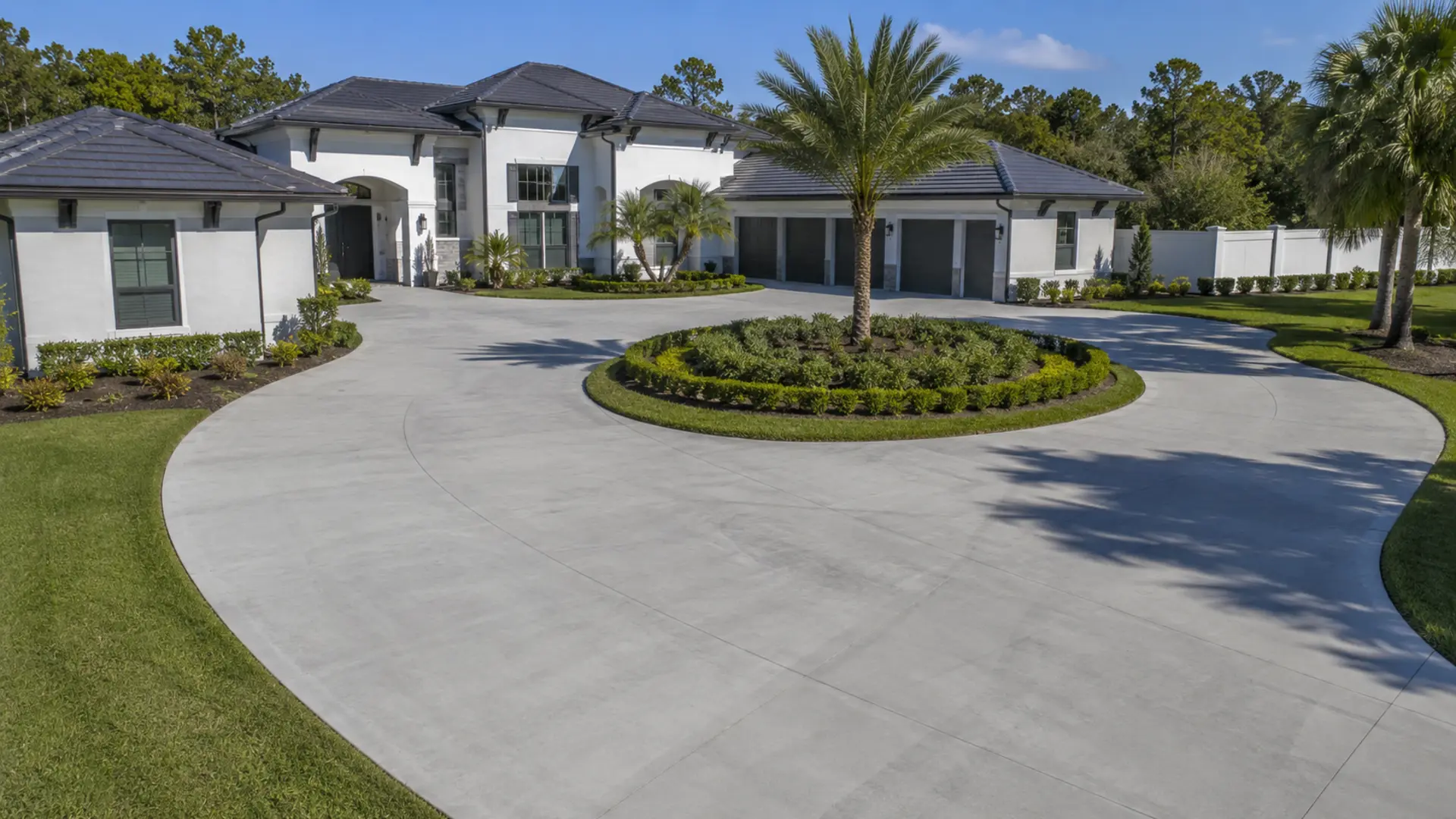
Lakeland Concrete Driveway Experts design and pour circular and carriage driveways for homeowners across Lakeland Highlands, Christina, Eaglebrooke and the larger lots throughout Polk County. Our reputation rests on delivering every project we take on, using the best materials for the application, meeting or exceeding Florida Building Code, and writing each specification around the property, the vehicles and the Central Florida ground beneath it.
A circular drive is the least templatable job we do. The inner radius has to let a real vehicle follow the curve, the width has to work at the tightest point rather than on the straight, both street connections have to satisfy right-of-way requirements, and mature oaks and island planting have to be designed around rather than discovered halfway through. We have built compact loops on shallow setbacks and full carriage drives with entry courts on estate frontages. The sections below cover the design choices, the geometry that decides whether the loop is usable, why a curve is built differently from a straight run, and what it costs here.
A circular driveway is a layout before it is a slab, and these decisions change how the finished drive is used rather than only how it photographs. Island planting affects drainage at the inner edge, an entry court gives guests somewhere to stand, and a spur to the garage keeps daily parking out of the middle of your entrance. Lighting conduit belongs in this conversation too, because it is cast in at pour time and cannot be retrofitted afterwards.
Raised or flush. Raised beds need fall away from the concrete so irrigation does not undermine it.
Widening in front of the door, giving guests standing space without blocking the loop.
A branch off the loop so daily parking does not sit in the middle of the entrance.
A stamped or aggregate border tracking the curve, emphasising the geometry.
A continuous edge holding sand and mulch back from a long unsupported perimeter.
Sleeves cast in at pour time for island and verge lighting, which is impossible to retrofit.
Geometry separates a circular driveway people use from an expensive ornament they avoid. A curve that reads beautifully on a plan can be one a full-size pickup cannot follow without mounting the island, and a drive measuring twelve feet on the straight effectively narrows through the turn because vehicles track wider when turning. These are the figures we stake out and drive on the ground before any forms go in.
The working minimum for ordinary family vehicles, and more where a truck uses it.
Twelve on the straight narrows through the curve, because vehicles track wider when turning.
We mark the full layout on the ground and drive the actual geometry before committing.
Checked against the largest vehicle that will regularly use it, not an average car.
Both street connections angled so vehicles enter and exit without swinging wide.
Exit points positioned so you can see oncoming traffic before the nose reaches the road.
A circular drive is not a straight driveway bent into a shape. Vehicles apply lateral force as well as vertical load, repeatedly on the same arc, so slab depth, steel and joint layout all change. Reinforcement follows the curve rather than being chorded across it in straight lengths, and joints are cut radially so that none of them ever run along the line a wheel tracks.
Turning vehicles apply lateral force as well as vertical, repeatedly on the same arc.
Steel follows the curve rather than being chorded across it in straight lengths.
Where stress concentrates most as vehicles track the tightest line.
Bender board or masonite staked at close centres to hold a true arc with no flat spots.
Cut perpendicular to the direction of travel so no joint runs along a wheel path.
Each connection is separate permitted work at six inches with reinforcement.
The build standard through the curve.
A circular concrete driveway takes longer than its square footage suggests, and almost all of the extra time sits in the setting out rather than the pour. Striking radii, staking the layout, driving the geometry, bending steel to the curve and staking flexible forms at close centres is a day of work before excavation even begins.
Island centre set, radii struck, and the full layout staked so you can walk and drive it.
Two street connections means two right-of-way aprons in the permit scope.
Following the staked line, with mature island planting left undisturbed where retained.
Compacted limerock, then bender board staked at close centres to hold a true arc.
#4 rebar bent to the radius, with tighter spacing at the inner curve.
Placed and finished, radial joints cut perpendicular to travel, seven day cure.
Square footage understates the work, and the lot decides whether it is the right spend.
Two things drive the cost beyond area. Both street connections have to be built to right-of-way specification at six inches and both go through permitting, which is real money and real schedule. And the setting out, striking radii, staking the layout, testing the geometry, bending steel to the curve and staking flexible forms at close centres, is a day of work before excavation even begins, plus consumable forming that a straight drive does not need.
Straight answers, including the ones that talk you out of spending money.
Roughly seventy feet of frontage and about forty feet of setback gives room for a workable loop at a twenty-four foot inner radius and twelve to fourteen feet of width. Less than that and the curve tightens until full-size vehicles clip the island. We measure and stake it before saying yes.
Turning vehicles apply lateral force as well as vertical load, repeatedly on the same arc. Five inches through the curve with a #4 rebar grid handles that. A four-inch slab designed for straight-line traffic shows stress cracking at the inner radius within a few years.
Yes. Each connection to the road is a right-of-way apron in its own right, requiring six-inch reinforced concrete and its own approval. That is a genuine part of both the cost and the schedule on a circular drive.
A fountain generally yes, with drainage designed so overspray runs away from the concrete rather than under it. A large tree is riskier, since species like live oak have aggressive surface roots that lift slab edges. A root barrier and generous separation help, and we would discuss species before you plant.
Often not, and we will say so. Without the frontage for a proper radius you get a cramped loop people stop using. On an estate lot with a deep setback it changes the whole approach to the house. The measurement decides it rather than the aspiration.
We will measure the frontage, stake the layout on the ground and let you drive it before anything is committed.
863-734-6623