
Full Apron Replacement
Existing apron saw cut at the property line, removed and rebuilt to municipal profile.
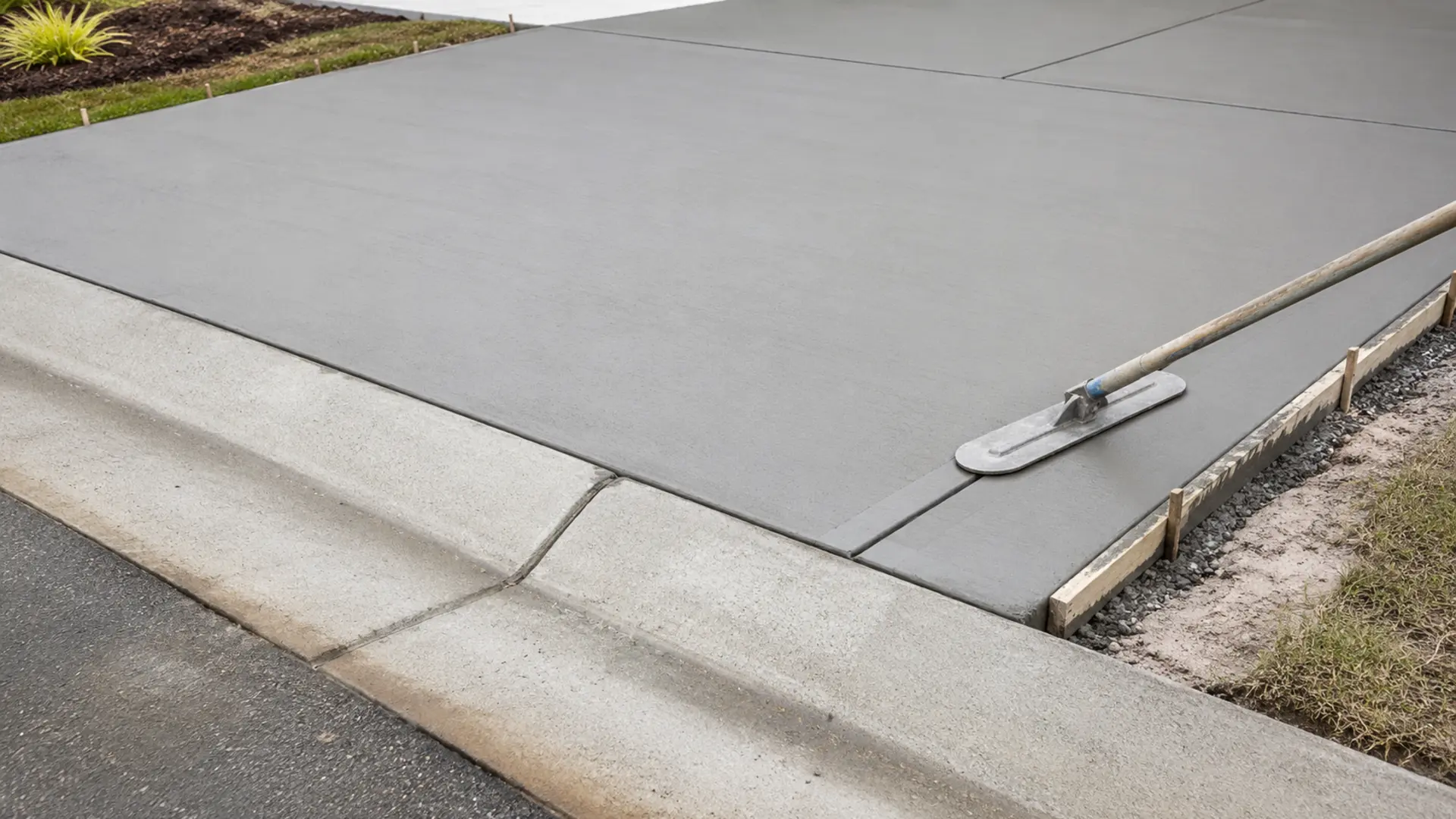
Lakeland Concrete Driveway Experts build and replace concrete driveway aprons to City of Lakeland and Polk County right-of-way standards. We have earned our reputation by delivering on every job we take on, building to meet or exceed the municipal specification rather than the driveway behind it, and handling the approvals and inspection from application to sign-off.
The apron is the one section of driveway you do not fully control, and it cannot be built to preference. It sits in the public right-of-way, the thickness, mix, reinforcement and flare geometry are fixed by the approved permit, and it is also the hardest working concrete on the property, every vehicle you own crosses it, and refuse and delivery trucks clip the outer corner while manoeuvring. We have replaced aprons that failed at driveway thickness, built first connections where none existed, and permitted second aprons for circular drives. Below covers the work, why aprons fail early, what the right-of-way requires and who is responsible for it.
This is the concrete driveway apron work we carry out, all built to right-of-way specification. Full replacements, broken corner repairs where refuse and delivery trucks clip the edge, first connections where no apron exists, and second aprons for circular drives.
Existing apron saw cut at the property line, removed and rebuilt to municipal profile.
A first connection to the road where no apron exists, permitted from scratch.
The outer corner where trucks clip it, cut back to sound concrete and repoured.
Flaring the connection so vehicles turn in without mounting the kerb or verge.
Each connection to the road is separate work with its own approval.
Matching the existing kerb profile so water still runs to the gutter line.
Driveway aprons fail before the driveway does for two recurring reasons, and we are called out to fix both constantly. One is an apron poured at driveway thickness rather than the six inches the right-of-way requires. The other is a missing full-depth expansion joint at the property line.
Four inches instead of six. Looks identical on day one, breaks at the corner by year four.
Fibre only, where the right-of-way specification calls for mesh or steel.
No separation at the property line, so road movement transfers into your slab.
Cut rather than a full-depth compressible joint, which is not the same thing.
A tie-in that does not match, so water ponds instead of running to the gutter.
Which surfaces years later during a title search or a property sale.
What the right-of-way requires of a driveway apron is set by the municipality rather than by preference, and none of it is negotiable. Thickness, mix strength, reinforcement, joint placement, width and flare geometry are all fixed by the approved permit.
Regardless of what the driveway behind it is built to.
With 4,000 PSI commonly specified on higher-traffic connections.
Fibre mesh or steel rebar, depending on the jurisdiction and location.
At the property line, separating municipal work from private work.
Geometry set by the permit rather than chosen on site.
The permit closes on inspection, which we schedule and attend.
This is the concrete driveway apron specification, built to City of Lakeland and Polk County right-of-way standards. The expansion joint at the property line is not optional and is not a saw cut, it is full-depth compressible material separating municipal work from private work.
On driveway apron work the approvals sit at the front and take considerably longer than the construction. Confirming jurisdiction, submitting the right-of-way permit and waiting on review is measured in weeks; the pour itself is two days.
Whether the road is City of Lakeland or Polk County decides which specification applies.
Application with proposed width, flare geometry and specification. No work before approval.
811 marking. Utilities run more densely along right-of-way corridors than anywhere on the lot.
Existing apron saw cut at the property line and removed, base excavated and compacted.
Forms set to the existing kerb profile with continuous fall, expansion joint placed.
Six-inch reinforced pour finished, then the municipal inspection scheduled to close the permit.
Who owns the driveway apron is the part homeowners are usually unclear on. The land is public right-of-way so it is not yours, but in most cases the adjoining owner is responsible for maintaining it, which is why a permit is needed and why unpermitted work surfaces at sale.
The apron sits on public land, so you do not own it, but in most cases the adjoining property owner is responsible for maintaining it. That is why you need a permit to work on it and why the municipality sets the specification rather than you. It also means a broken apron is generally your problem to fix even though the ground belongs to the city or county. We confirm the position for your specific address before quoting.
Straight answers, including the ones that talk you out of spending money.
The apron sits in the public right-of-way, so the land is not yours, but in most cases the adjoining owner is responsible for maintaining it. That is why a permit is required and why the municipality sets the specification. We confirm the position for your address before quoting.
Because of what crosses it. Every vehicle you own passes over it, and refuse trucks, delivery vans and utility vehicles regularly clip the edge while manoeuvring in the street. Six inches with reinforcement handles that; a four-inch apron typically fails at the outer corner within a few years.
Yes, and it is a common job. It is saw cut at the property line so your existing driveway keeps a clean square edge, and the new pour is separated from it by a full-depth expansion joint. That joint is what lets each section move independently.
It varies with jurisdiction and current volume, and it is genuinely the longest part of the timeline. Plan for a few weeks rather than days. We prepare and submit the application, but the review period is outside anyone’s control.
The municipality can require its removal and reconstruction at your expense, and it complicates a property sale when it surfaces during title or inspection. On a section this small relative to the whole driveway, it is not worth the risk.

We confirm the jurisdiction, handle the right-of-way application and attend the inspection that closes it.
863-734-6623