
Light Broom
Fine, subtle striations. The tidiest look, and the easiest surface to sweep clean.
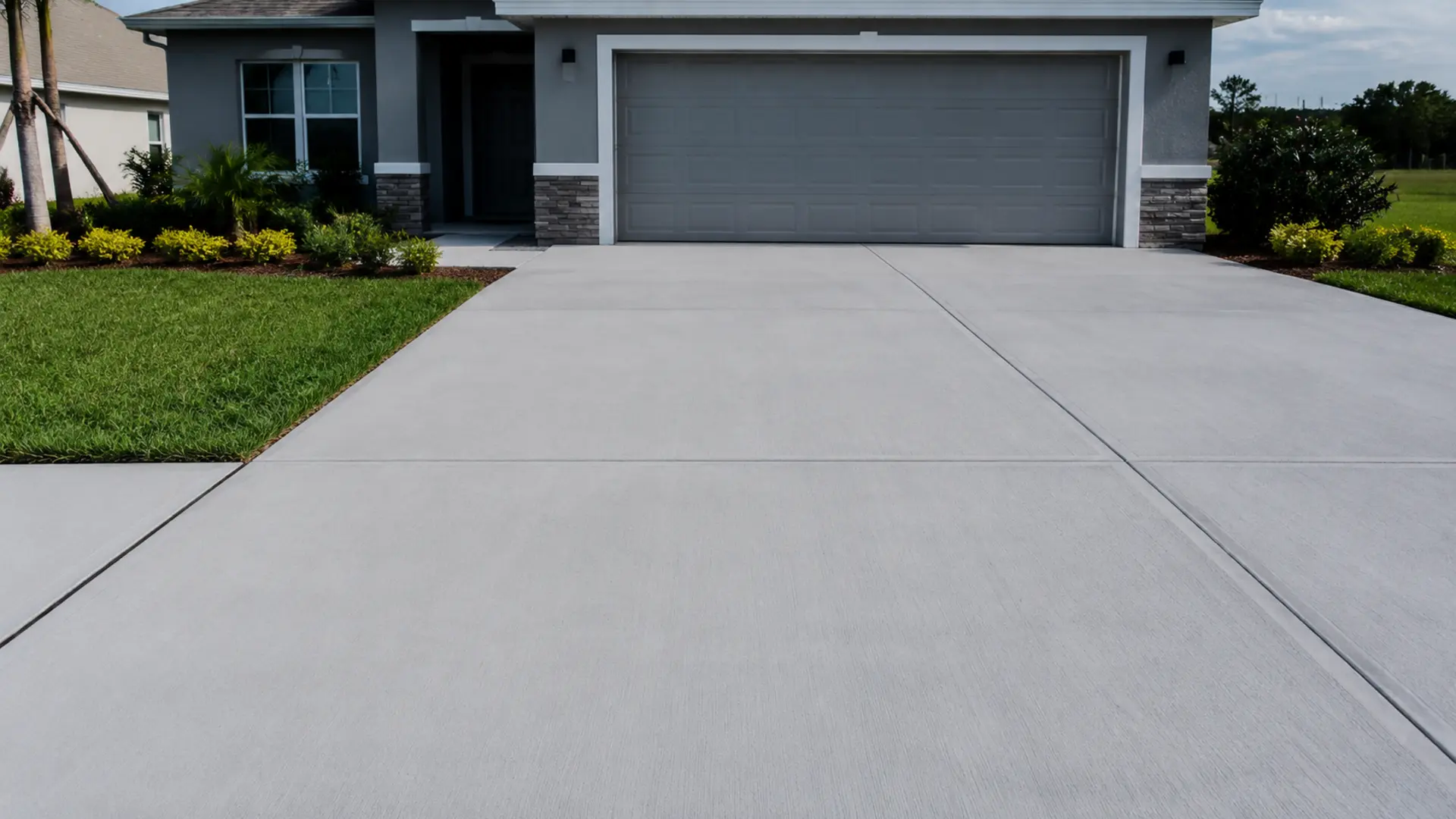
Lakeland Concrete Driveway Experts pour broom finish concrete driveways for homeowners, landlords and commercial owners throughout Lakeland and Polk County. Our reputation rests on delivering every project we take on, using the best materials for the application, building to meet or exceed Florida Building Code and local requirements, and writing each specification around the property, the vehicles and the ground beneath it.
A broom finish is the most honest driveway we build, because there is nothing decorative to hide behind. That also makes it the least templatable, with no finish premium in the price, the difference between two quotes is entirely excavation depth, base compaction, reinforcement and joint timing. We have poured single-car drives on older Auburndale streets, long approaches across Kathleen acreage and working yards where mud and grip mattered more than looks. What follows covers the broom options, what actually decides how long a plain driveway lasts, where this finish beats a decorative one and what it costs here.
There is more variation in a broom finish driveway than most people expect, and it changes both grip and appearance. Light striations sweep clean and look tidiest; heavy broom gives real traction on a sloped drive; horsehair reads finer than wire on a visible frontage. The direction matters too, drawn across the slope rather than down it.
Fine, subtle striations. The tidiest look, and the easiest surface to sweep clean.
The standard residential specification. Good wet grip without holding sand and debris.
Coarse, deep texture for sloped drives where traction matters more than appearance.
A softer, finer line than wire. Reads more refined on a visible front elevation.
Swept in a gentle curve rather than straight across, following a curved drive.
A smooth banded edge framing the broomed field, giving a defined finished line.
On a broom finish driveway there is nothing decorative to hide behind, so lifespan is decided entirely by what goes in underneath. None of it is visible on handover day and all of it decides year twenty: excavation depth, base compaction, whether there is a tied steel grid on chairs, and when the joints were cut.
Dug to firm bearing material rather than a fixed number, so depth varies across a site.
Four inches of limerock placed in lifts and brought to density, not just tipped and levelled.
95% Modified Proctor verified. A base thickness with no compaction standard is a hope.
A rebar grid lifted into the middle third, where it can carry load rather than sitting on rock.
Saw cut within twenty-four hours. Cut late and the slab has already chosen its own crack line.
Concrete reacts rather than dries. Rushing this is how a surface ends up dusting.
These are the situations where a broom finish concrete driveway is genuinely the better choice, and where we would talk you out of a decorative finish rather than into one. Zero maintenance, rental and investment property, long rural runs, working yards and period frontages all point the same way.
No pigment and no sealer cycle. Wash it occasionally and otherwise forget it.
Durable, cheap to repair, and nothing that looks neglected if it is not maintained.
Where the area is large enough that a decorative finish becomes hard to justify.
Where mud, equipment and heavy vehicles matter more than appearance.
Where a plain, correctly jointed slab sits better than imitation stone.
Spend it on depth, steel and compaction instead of the surface. It lasts longer.
This is the full residential build standard behind a broom finish concrete driveway. It is identical to what sits under a stamped or exposed aggregate drive, only the surface changes, which is exactly why a well-built plain driveway outlasts a badly built decorative one by decades.
A broom finish concrete driveway is two days on site for a standard residential drive, plus the cure. The step that decides the surface quality is waiting for bleed water to evaporate before the broom is drawn, too early and the finish tears open and sheds dust for years, too late and the texture disappears within a season.
811 utility marking, then topsoil and organics stripped down to firm sub-grade.
Limerock placed in lifts and compacted to density. This decides whether it settles.
2x6 forms staked every four feet, holding a two percent fall away from the house.
Rebar grid tied on eighteen-inch centres and set on chairs; fibre comes pre-batched.
Concrete placed and floated, then left until bleed water has gone before finishing.
Edges tooled, broom drawn across the slope, joints cut within a day, wet cured.
What a broom finish concrete driveway costs in Polk County, and why two quotes for the same square footage differ so much. With no decorative work in the price, the difference between them is almost entirely base depth, compaction and whether there is real steel in the slab.
Square footage is the starting point and rarely what separates two quotes. Removing an existing slab is its own line of work, and a reinforced older driveway takes considerably longer to break out than a plain one. Sub-grade condition is the biggest unknown: clean sand needs a standard base, while organic muck or a clay pocket needs over-excavation and imported fill. Going from four inches to six with heavier steel is roughly a fifty percent material increase, which is money well spent for an RV and wasted on a sedan.
Straight answers, including the ones that talk you out of spending money.
Four inches over a properly compacted four-inch limerock base handles cars and light trucks. Go to five or six where an RV, boat trailer, dually or delivery truck crosses regularly. The thickened six-inch edge matters at least as much as field thickness, because edges break first.
Concrete shrinks as it cures and moves with temperature. It will crack; joints decide where. On a four-inch slab they go in at eight to ten feet, at least an inch deep, within twenty-four hours. That matters more here because a hot slab hit by an afternoon storm contracts fast.
Optional rather than required. Sealing reduces oil staining and slows algae on shaded drives under oak canopy. It also makes the surface slightly slicker when wet. Plenty of Lakeland homeowners never seal a broom finish and get decades out of it.
Foot traffic after twenty-four hours, cars after seven days, and heavy vehicles at twenty-eight when the concrete reaches design strength. Driving on it early does not always crack it, but it uses up strength the slab has not developed yet.
Not reliably, and this is the main honest limitation of patching or extending an older driveway. New concrete cures lighter and takes years to weather toward the old slab. Staining across both areas gives a far better result than trying to match a fresh mix.
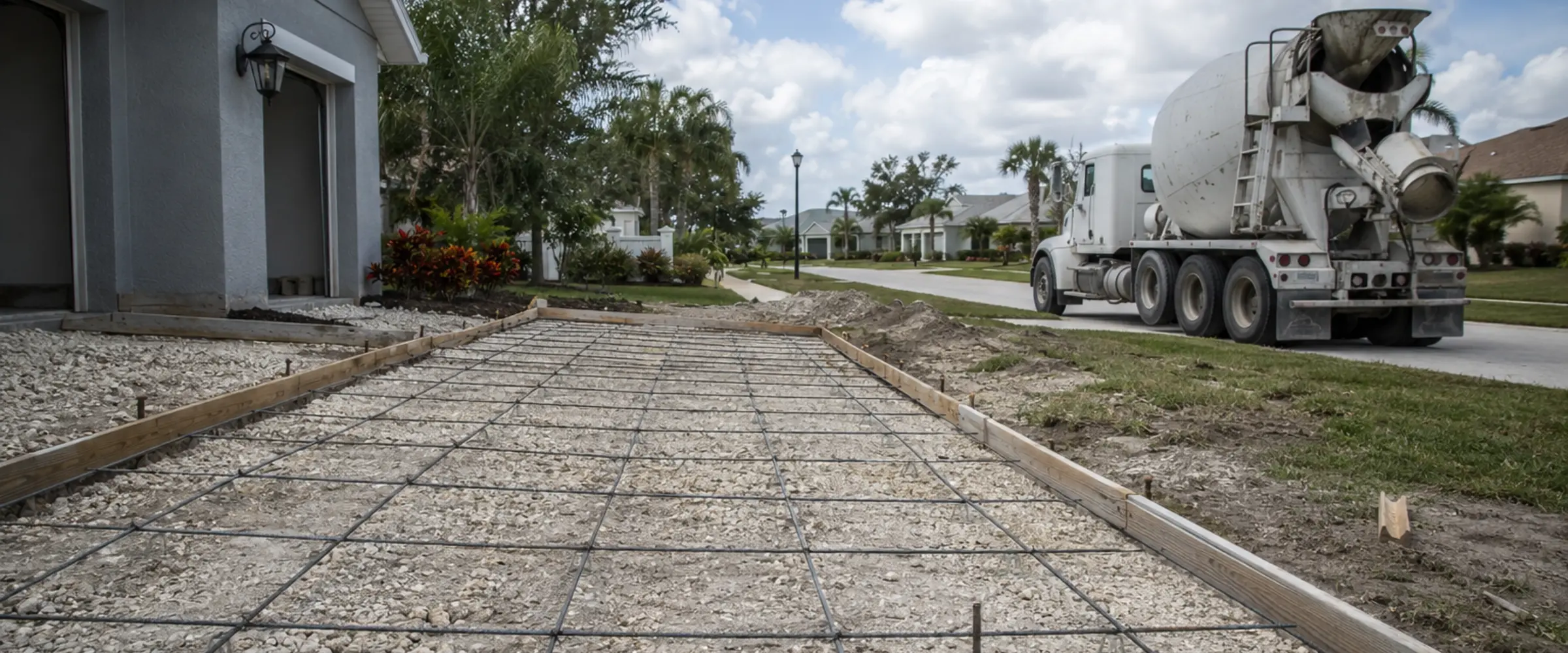
We will itemise the excavation, base, compaction and steel so you can see exactly where the money goes.
863-734-6623