
Crack Routing & Sealing
Chased to a clean channel and filled with an elastomeric sealant that flexes with the slab.
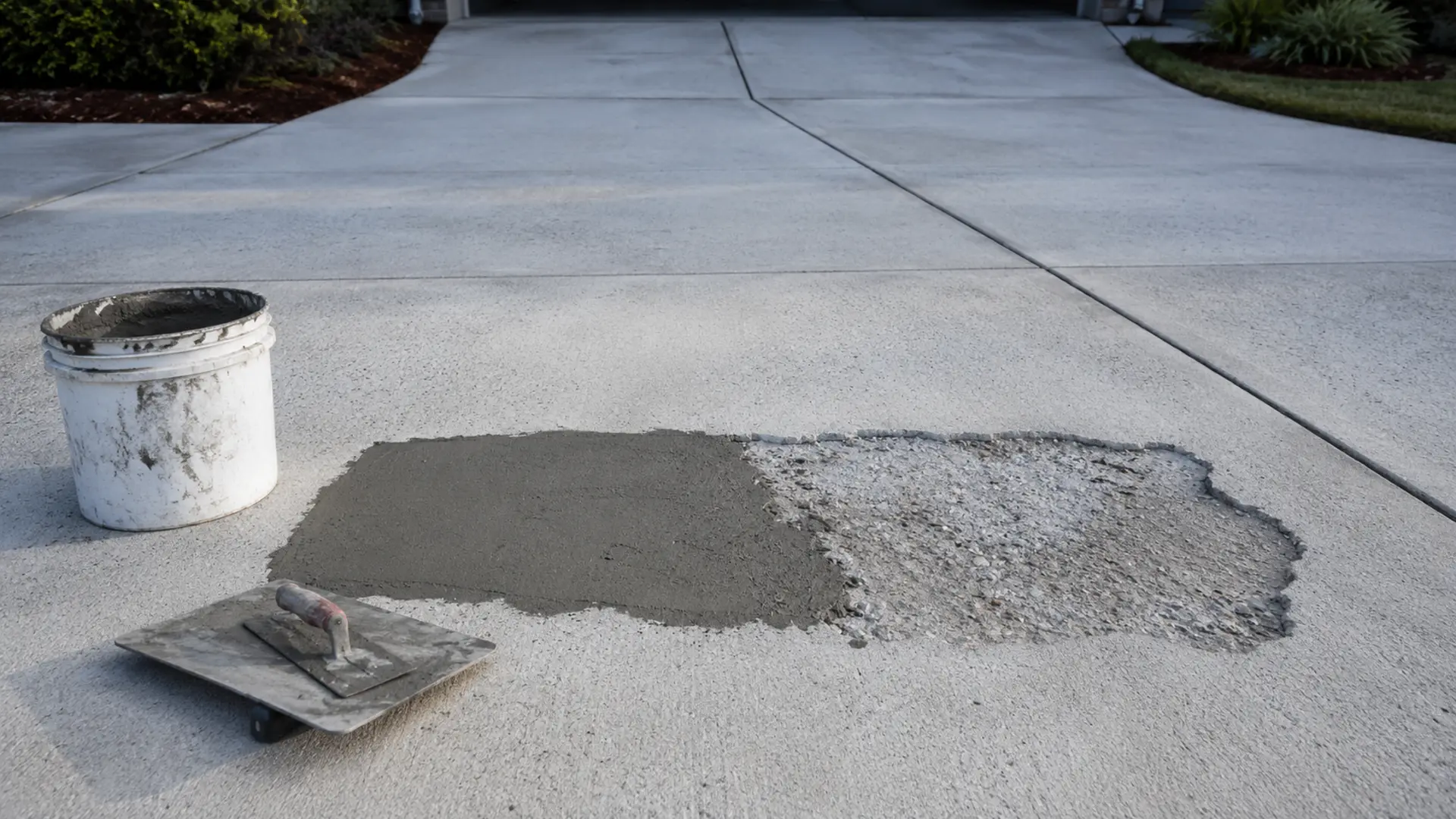
Lakeland Concrete Driveway Experts repair concrete driveways for homeowners, landlords and commercial owners across Lakeland and Polk County. We have earned our reputation by delivering on every job we take on, using the right material for the failure in front of us, working to meet or exceed Florida Building Code and local requirements, and writing the fix around your slab rather than a template.
A good share of our repair work starts with somebody who has already been quoted for a full replacement and wants a second opinion. Frequently they should have one, because a driveway that looks terrible can be structurally sound. We have routed and sealed cracks on forty-year-old slabs, rebuilt edges undercut by years of runoff, and milled and re-capped spalling that other contractors had simply painted over. What follows covers the repairs we carry out, how we decide which one your driveway needs, the damage we see most often here, and what it costs.
These are the concrete driveway repairs we carry out across Lakeland and Polk County, and each one is matched to a different failure. Cracks that still move need a flexible filler; cracks that have stopped need epoxy. Spalling needs milling before capping. Potholes need excavating to sound base. Using the wrong method is why so many previous repairs have failed.
Chased to a clean channel and filled with an elastomeric sealant that flexes with the slab.
For cracks that have genuinely stopped moving, restoring strength across the break.
Loose surface milled back to solid concrete, then re-capped with polymer-modified mortar.
Squared out to sound base, bonded, and filled with rapid-set structural concrete.
Crumbled perimeters undercut, doweled, re-formed and poured with the base corrected beneath.
The section at the street where delivery and refuse trucks clip it, rebuilt to spec.
The assessment is free and it is the part that saves people money, because the difference between a repair and a replacement is usually invisible from the kerb. We sound the slab for hollow areas, straight-edge the cracks for vertical displacement, and check the joints and edges. That tells us whether the problem sits on the concrete or under it.
If one side sits higher, that is movement, and filling it treats a symptom.
Tapping reveals delaminated areas that look fine but will lift within a season.
A hollow note under a heel means the support underneath has washed away.
Failed or missing control joints are where most cracking starts on Florida slabs.
Downspouts, irrigation and fall across the site cause more damage than traffic does.
Map cracking is cosmetic crazing; a single long crack is a structural story.
This is the concrete driveway damage we are called out to repair most often in Polk County, and what is actually behind each one. Sandy sub-grade, unrestrained edges, joints cut too late and slabs finished over bleed water account for the overwhelming majority of it, and none of those are visible once the driveway is down.
Sandy sub-base washed out from an unsupported perimeter, then a wheel ran slightly wide.
Finished over bleed water when it was poured. A surface fault, not a base fault.
Seasonal soil movement under a slab with no steel in it to resist the flex.
Iron in well-water irrigation. Treatable with a reducing agent, not a structural issue.
Algae and lichen on a slab that never dries out. Chemical treatment, then sealing.
Backfill around the foundation consolidating. Usually a lifting job.
These are the materials and the geometry behind a concrete driveway repair that is still there in five years. The single most common reason a patch fails is that it was feathered out to nothing at the edges, where there is almost no bond area and no mechanical key for traffic to work against.
Most residential concrete driveway repairs are a single day on site, and the sequence is the same whether we are patching a spall or routing a crack. The step people skip is cleaning the cut faces properly, sealant and mortar will not bond to concrete dust, and that alone accounts for a good share of the failed repairs we are asked to redo.
We check for movement and delamination, because that decides rigid versus flexible repair.
Unsound concrete usually reaches well beyond the visible damage, and it all has to go.
Saw cut to vertical faces and excavate to solid material or sound base.
Bonding agent on every face, then structural mortar or rapid-set concrete placed and tamped.
Hand worked to match the surrounding broom or texture as closely as possible.
The joint or crack that let water in gets routed and sealed, or it recurs nearby.
Honest expectations on concrete driveway repair cost and lifespan before you spend anything. A properly executed structural patch on a sound slab gives five to ten years; a routed and flexibly sealed crack holds eight to ten. Both assume the underlying cause has been understood, which is why we survey rather than pricing from a photograph.
A properly executed structural patch on a sound slab should give five to ten years and frequently longer. A routed and flexibly sealed crack should hold eight to ten before the sealant needs renewing. An epoxy-injected stable crack is effectively permanent. All of those assume the underlying cause has been understood, which is why we survey rather than pricing from a photograph.
Straight answers, including the ones that talk you out of spending money.
Approximately, and it improves as it weathers, but it will not be invisible. New material cures lighter than a slab that has been in the sun for years. Where a uniform appearance matters more than cost, resurfacing the whole driveway is the honest answer.
Five to ten years for a structural patch on a sound slab, eight to ten for a routed and sealed crack, and effectively permanent for an epoxy-injected stable crack. A repair on a slab that is still moving will fail faster because the cause has not been dealt with.
If the crack has stopped moving, yes, epoxy injection restores continuity across it. If it still opens and closes seasonally, the right answer is a flexible sealant that accommodates that movement. Filling a moving crack with rigid material simply cracks it again alongside.
Because concrete around a spall or pothole is nearly always unsound before it visibly breaks. Sounding reveals delamination well beyond the hole, and leaving it means the patch perimeter fails first. It is where the solid concrete starts, not an upsell.
Foot traffic after a day and vehicles after about three for standard structural mortars. Where the driveway is your only access we can specify a rapid-set material that takes traffic in four to six hours.

Get a second opinion first. We will sound the slab, tell you what is actually wrong, and quote the smallest job that genuinely fixes it.
863-734-6623