
Integral Pigment
Iron oxide mixed into the batch. Colour runs the full slab depth and cannot fade off.
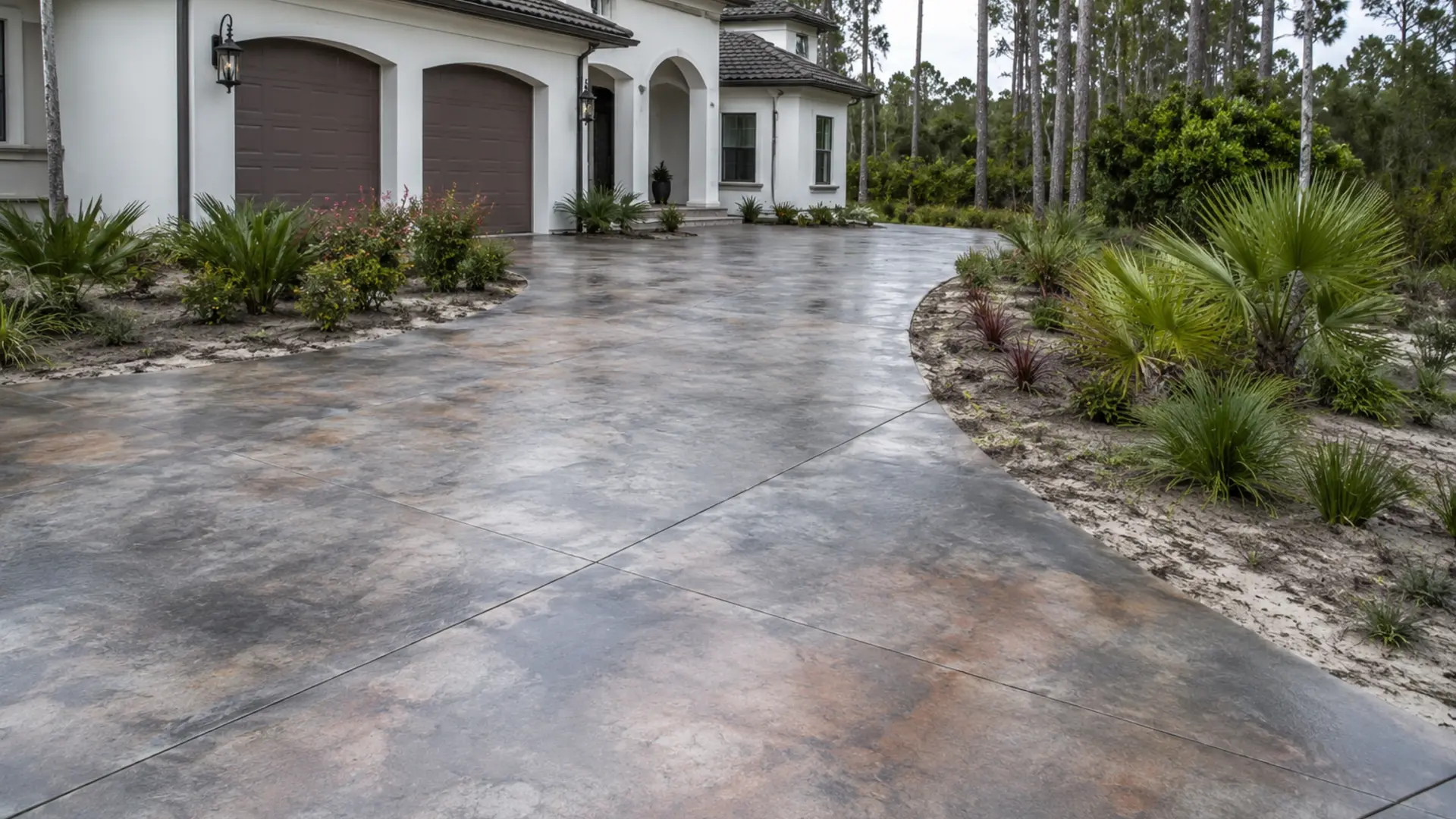
Lakeland Concrete Driveway Experts stain and colour concrete driveways for homeowners and commercial owners across Lakeland and Polk County. We have earned our reputation by delivering on every job we take on, using UV-stable mineral colour systems suited to this climate, working to meet or exceed code and manufacturer requirements, and specifying the colour around your property rather than a card.
Colour cannot be templated, because acid stain is a chemical reaction rather than a coating and no two slabs take it identically. Areas troweled harder are denser and take less; ground near a joint that dried faster takes more. That mottling is the point of the finish, and it also means we stain a discreet area of your own driveway and seal a square foot before anyone commits. We have coloured new pours at the batch plant, acid-stained twenty-year-old slabs that only needed the surface addressed, and matched extensions into existing drives. Below covers the three colouring methods, the directions that work here, colouring an existing slab and how it ages.
Pick the colouring method before you pick the colour, because the three behave completely differently over ten years in this sun. Integral pigment runs through the full slab depth and cannot fade off. Acid stain reacts chemically with the cured concrete and cannot peel. Water-based stain reaches colours the other two cannot, and depends entirely on the sealer above it.
Iron oxide mixed into the batch. Colour runs the full slab depth and cannot fade off.
Metallic salts react with lime in the cured slab, forming permanent mineral colour that cannot peel.
Pigment in the surface pores. Far wider colour range, and wholly dependent on the sealer.
Broadcast into the fresh surface for richer colour and a harder, denser wearing layer.
Integral base with acid stain over it, giving depth neither method achieves alone.
Bright and uniform, but not UV stable. We do not recommend it outdoors and will say so.
Concrete driveway colour should be chosen against your roof tile, stone veneer and landscaping rather than off a card in isolation. Warm sand and buff soften bright stucco, terracotta picks up barrel tile, and charcoal reads modern while hiding tyre marking. These are the directions that consistently work on Central Florida elevations.
Softens a bright white or cream stucco elevation without fighting a tile roof.
Picks up barrel tile and brick, common on the Mediterranean-style builds here.
Modern and graphic against contemporary stucco, and it hides marking well.
The classic acid stain result, with variegation that reads like natural stone.
A darker stained band framing a lighter field, defining the edge of the drive.
Staining new and old together is the reliable way to make an extension disappear.
Staining an existing concrete driveway is often possible and dramatically cheaper than replacing a slab with nothing structurally wrong with it. The conditions are specific though: the slab has to be sound, never previously sealed, and not so hard-troweled that it refuses to take colour evenly. We check all three before quoting.
Flat, no dropped panels, no cracks with a lip. We check before quoting anything.
Old sealer, coatings and tyre rubber all block the reaction and have to come off first.
Very densely finished concrete takes stain patchily, and we will warn you upfront.
Grinding or scarifying opens the surface so the stain can actually get into it.
Stained and sealed on a discreet area so you see the real wet colour on your own slab.
Residual acid trapped under a sealer will lift the coating within a season.
These are the materials, coverage rates and sequence that make colour last on a concrete driveway. The step that catches people out is neutralising, acid left under a sealer will lift the coating within a season, and it is one of the most common reasons a stained driveway fails early.
On a new pour the colour goes in during the work; on an existing slab it is a separate visit after cure. Either way we stain a discreet area of your own driveway and seal a square foot of it first, because acid stain is a chemical reaction and a sample board only tells you the family of colour, not the result.
Colours looked at on site next to your roof tile, veneer and planting.
A discreet area stained and sealed so you see the finished wet colour before committing.
New slabs are cured and clean; existing slabs are stripped and mechanically opened.
Pigment batched at the plant, or stain sprayed and worked to develop the variegation.
Acid stain is neutralised to pH 7 and flushed, then the slab is left to dry through.
A UV-stable acrylic carrying a grip additive, which is what protects the colour.
Coloured concrete ageing in Florida sun comes down to a simple distinction: what actually fades and what does not. Iron oxide pigment and acid stain are mineral colour and hold for decades. The sealer above them chalks under UV and makes the colour look flat long before the colour itself has done anything.
Iron oxide pigment and acid stain are both mineral colour, and both hold for decades. What goes is the sealer above them, which chalks under UV and makes the colour look flat and dusty long before the colour itself has done anything. Reseal every two to three years and a stained driveway stays looking like the day it was finished. Water-based stains are the most exposed of the three, because they are a pigment film relying entirely on that coating.
Straight answers, including the ones that talk you out of spending money.
Integral iron oxide and acid stain are mineral colours and hold for decades. What fades is the sealer above them, which goes chalky and makes the colour look flat. Resealing every two to three years restores it. Water-based stains are the most vulnerable of the three.
Usually, if the slab is sound and has never been sealed or coated. Old sealer, tyre rubber and oil block the reaction and have to come off first. Very hard-troweled slabs take stain patchily, and we will tell you that before quoting rather than after.
Acid stain reacts with lime in the concrete to form permanent mineral colour in the surface. Dye is fine pigment carried into the pores with no chemical reaction. Dye is brighter and more uniform but far less UV stable, which rules it out outdoors here.
Integral pigment adds a modest cost per yard at the plant and is the cheaper route on a new pour. Acid staining is labour applied after cure and costs more. On an existing slab, staining is still far cheaper than replacement.
No, and be sceptical of anyone who says it will. Concrete colour varies with cement, moisture, weather and finishing. We aim for a colour family that works against the house and prove it on a sealed test patch on your own driveway first.
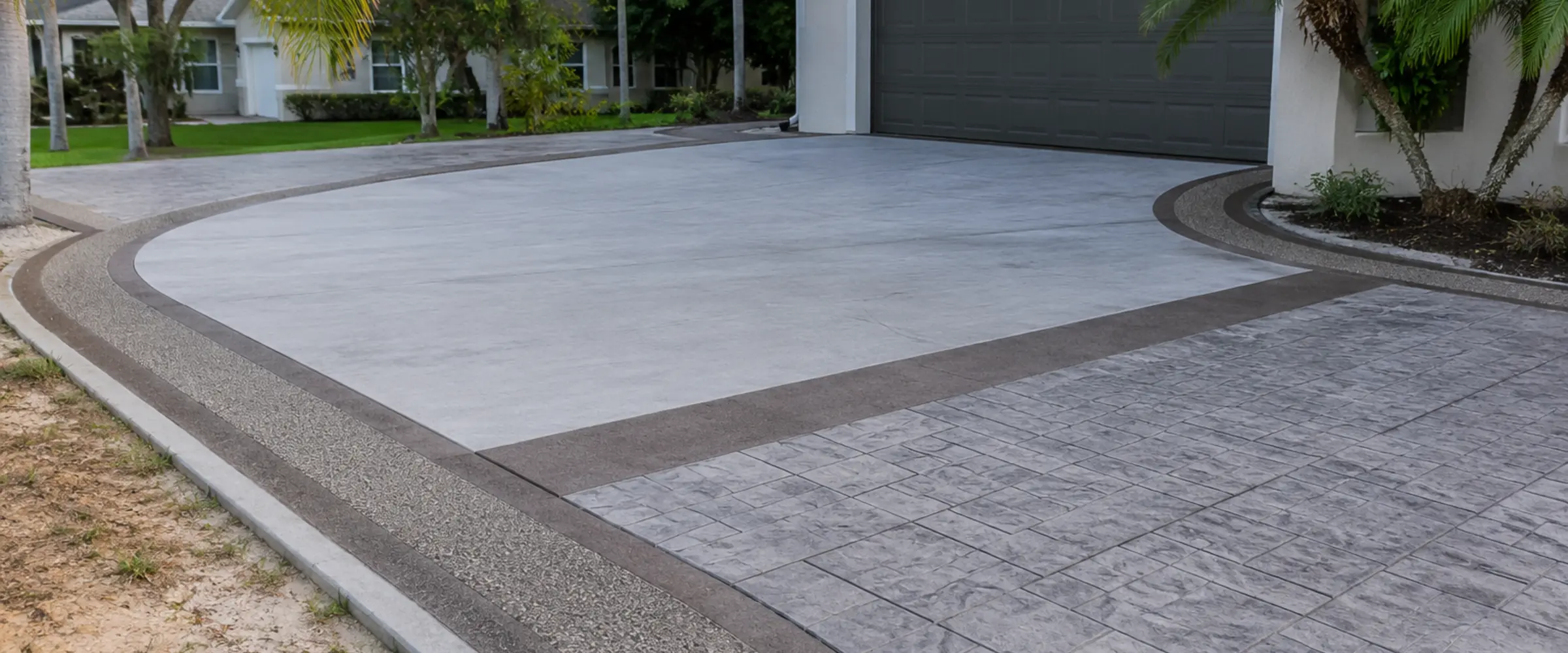
We will look at options against your roof and veneer, then prove the colour on a test patch before you commit.
863-734-6623