
Cream Finish
Barely opens the surface. Smooth, uniform and almost stone-like, with no aggregate showing.
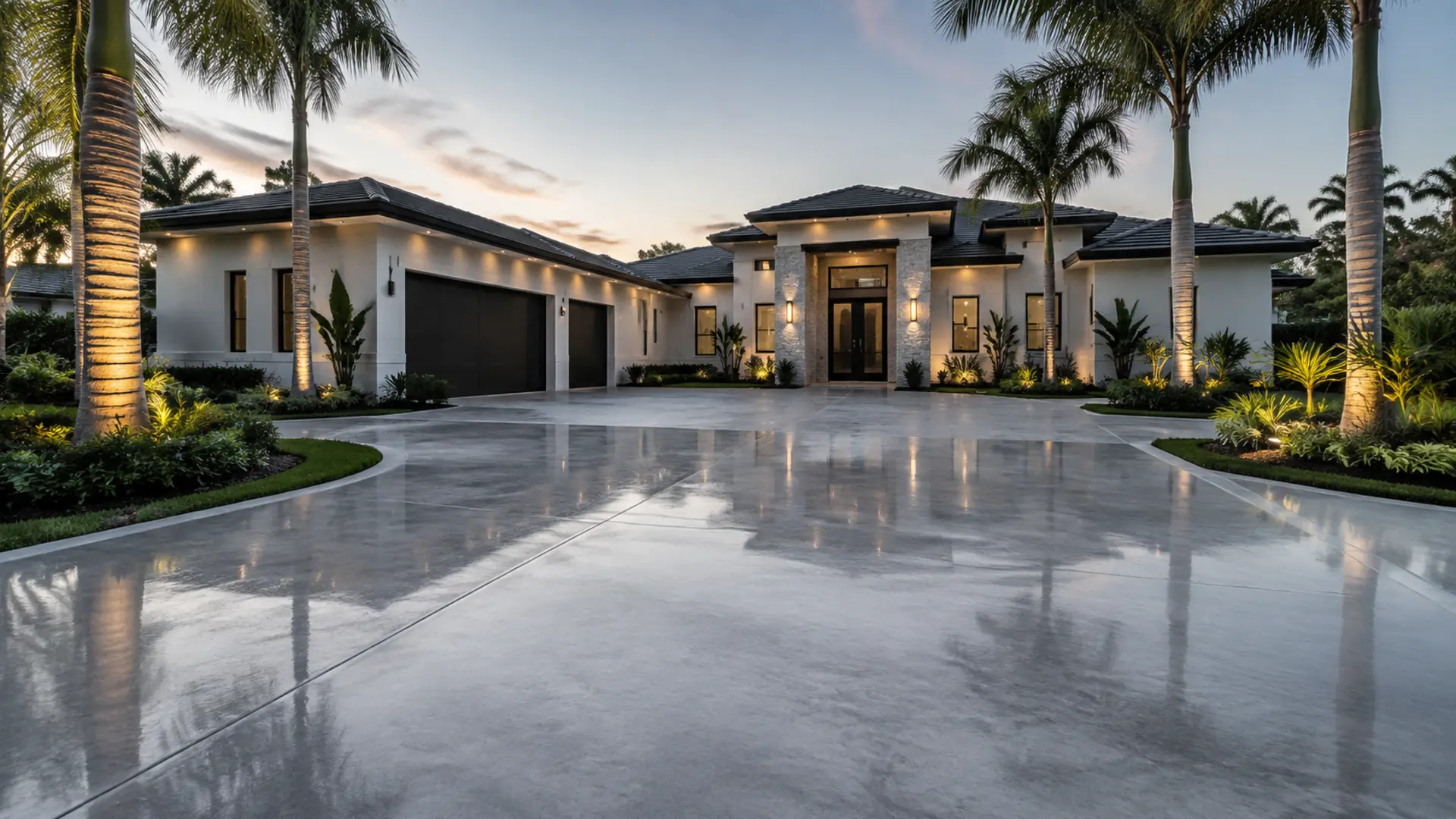
Lakeland Concrete Driveway Experts grind and polish exterior concrete for homeowners across Lakeland Highlands, Christina, Eaglebrooke and the wider Polk County area. Our reputation rests on delivering every project we take on, using the right tooling and densifier for the slab, meeting or exceeding code and manufacturer requirements, and ruling a site in or out honestly before anyone spends money.
Exterior polishing has to be said plainly: this is not the mirror-gloss floor you have seen in a showroom. We stop at a matte to satin sheen deliberately, because a high-gloss slab under Florida rain is genuinely unsafe. It also cannot be templated, aggregate exposure is set by the first grinding pass and is irreversible, and on an existing slab nobody knows what stone is in there until we cut a test area. We have polished contemporary entry courts and covered approaches, and we have also told people their driveway was not a candidate. Below covers exposure depth, what is in the system, where it suits and what it costs.
Aggregate exposure on a polished concrete driveway is set by the first grinding pass and it is irreversible. A cream finish barely opens the surface; salt-and-pepper cuts to the fine sand; full stone exposure reads like polished terrazzo. On an existing slab you cannot know exactly what is in there until you cut, which is why we grind a test area first.
Barely opens the surface. Smooth, uniform and almost stone-like, with no aggregate showing.
Cuts to the fine sand aggregate for an even speckled field. The most common choice.
Cuts down to the large aggregate and reads like polished terrazzo.
Stopped at 400 grit. The safest exterior finish and the one we specify most often.
Taken to 800 grit for more reflectivity, on flat approaches only.
On a new pour we can specify the stone to be polished into, rather than taking what is there.
There is no coating anywhere in a polished concrete system, every product works inside the slab. Metal-bond diamonds cut, a lithium silicate densifier reacts with free lime to harden the surface permanently, resin diamonds close the pores mechanically, and a penetrating guard sits in the pore structure rather than on top of it.
Coarse tooling for the opening passes that set exposure depth and flatness.
Reacts with lime in the concrete to form extra binder, hardening the surface permanently.
Fine tooling that closes the pores and develops sheen mechanically, not chemically.
A silane repellent sitting inside the pores, so there is no film to wear through.
Polyurea or epoxy supporting the joint edges under wheel loads while allowing movement.
An optional treatment that raises wet traction without changing the appearance.
A polished concrete driveway suits some sites and genuinely not others, and we would rather rule yours in or out before anyone spends money. Flat contemporary approaches and covered entries work well. Steep drives do not, because a polished surface on a slope in this rainfall is the wrong combination regardless of grit level.
Ideal. Modern architecture, gentle grade, and the finish reads as intended.
Where the driveway is a visible architectural element rather than just access.
Porte-cocheres and covered approaches, where rain rarely reaches the surface.
Not suitable. A polished surface on a slope is the wrong combination in this rainfall.
Not suitable. Grinding refines a surface; it cannot fix what is under it.
Needs 4,000 PSI and a hard-troweled surface. Weak concrete will not take a polish.
This is the polished concrete driveway specification and, importantly, where the grinding deliberately stops. Exterior work finishes at 400 to 800 grit with a matte to satin sheen. Grinding past that outdoors produces a surface that is genuinely dangerous when wet, so we will not do it regardless of the request.
The polished concrete grinding sequence is progressive refinement, and no step can be skipped. Each pass removes the scratch pattern left by the one before it, so missing a grit leaves marks from the previous pass visible in the finished surface permanently.
The slab is checked for soundness and cracks are filled with semi-rigid epoxy first.
Metal-bond diamonds at 50 grit cut through the cream and set the aggregate exposure.
Passes at 100 and 200 remove the previous scratch pattern. Flatness is achieved here.
Lithium silicate applied and left to react, chemically hardening the surface from within.
Resin-bond diamonds at 400 and 800 close the pores and bring up sheen with no coating.
Penetrating stain guard applied, and control joints filled with semi-rigid epoxy.
A polished concrete driveway is the most expensive finish we offer, because it is many hours of machine time with consumable diamond tooling and can only begin once the slab has fully cured. The argument for it is the absence of any coating to chalk, peel or renew.
This is generally the highest cost per square foot of anything on this site, because it is many hours of machine time with consumable diamond tooling and it can only start once the slab has fully cured. There is no way to shortcut the sequence, skip a grit and the scratch pattern from the previous pass stays visible forever. That is why it suits estate properties and contemporary builds where the driveway is a designed element rather than just a place to park.
Straight answers, including the ones that talk you out of spending money.
It would be at interior gloss levels, which is why we do not go there outdoors. Exterior work stops at 400 to 800 grit with a matte to satin sheen, and an anti-slip conditioner can be added. Even then it belongs on flat approaches rather than steep drives, and we will say so if your site is not suited.
Only if the slab is structurally sound, reasonably flat and at least 4,000 PSI. Widespread cracking, settled panels or heavy spalling rule it out, because grinding cannot fix a structural problem. We assess and grind a test area before quoting the full job.
Better than any coated finish, because there is no coating. The sheen comes from mechanically closing the concrete and hardening it with a lithium silicate densifier. Nothing sits on top to chalk, yellow or peel, which is the main practical argument for polishing over sealing.
Generally more. It is many hours of machine time with consumable diamond tooling, and it can only be done after the slab has fully cured. It suits properties where the driveway is a visible architectural element and the budget reflects that.
It resists both far better than untreated concrete because the surface is densified and closed, with a penetrating stain guard inside the pores. It is not stain-proof. Oil left for weeks in the sun will shadow, and the fix is a light re-polish rather than a chemical strip.

We will look at your slab, grind a test area so you can see the aggregate, and tell you honestly if your site suits it.
863-734-6623