
Surface Worn, Dusty or Grey
Ideal candidate. The slab is doing its job, the top layer has simply aged out.
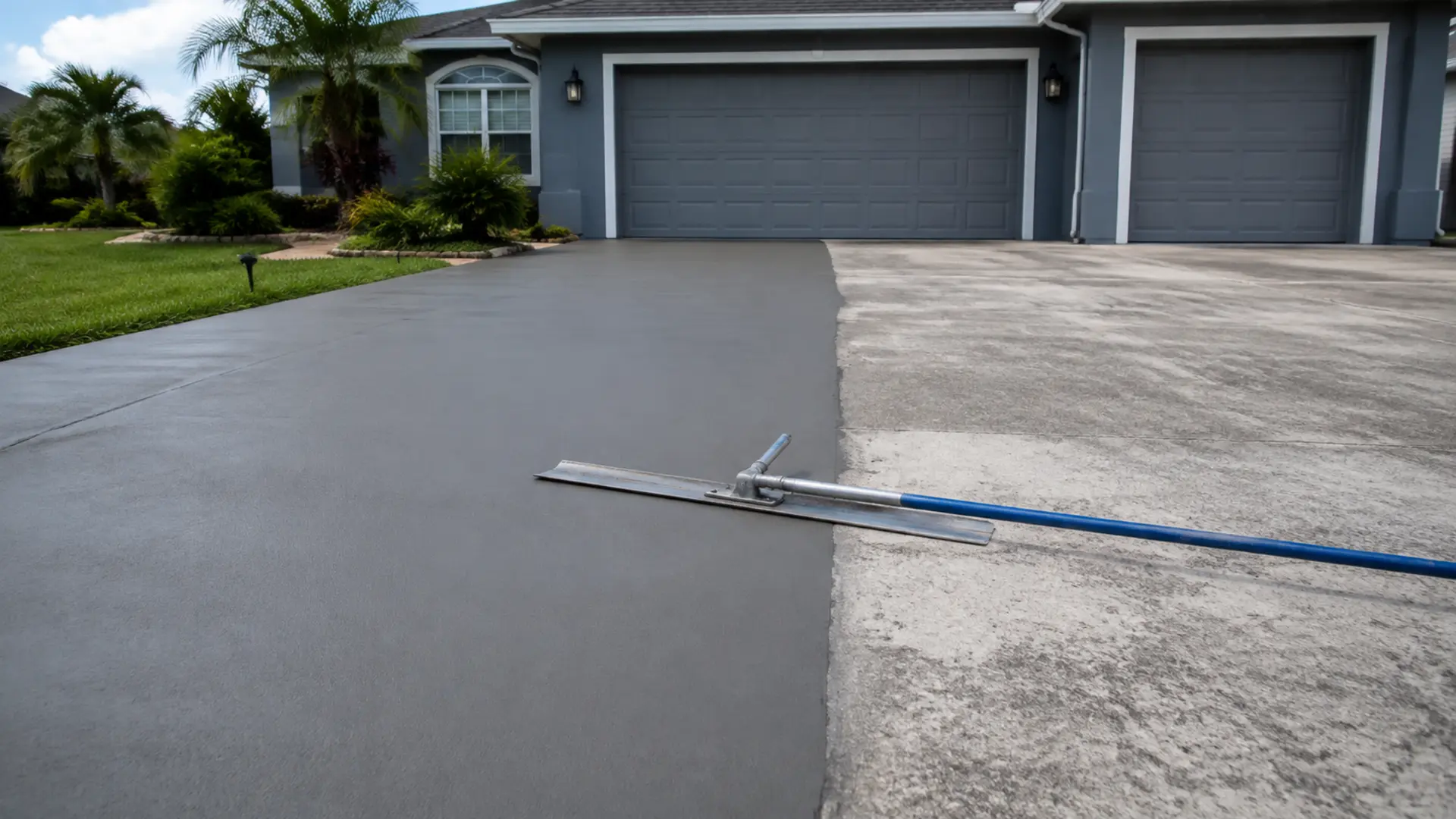
Lakeland Concrete Driveway Experts resurface concrete driveways for homeowners and commercial owners throughout Lakeland and Polk County. Our reputation here rests on delivering every project we take on, using the right overlay system for the slab underneath, building to meet or exceed Florida Building Code and local requirements, and specifying the work around your driveway rather than a standard package.
Resurfacing is the job we recommend most often to people who arrived expecting to be told they needed a replacement. It cannot be templated, because everything depends on whether the slab beneath has stopped moving, an overlay is a surface, not a structure, and it cannot hold a moving slab still. We have overlaid tired 1980s driveways into stamped and coloured finishes, and we have also told people their slab was not a candidate. The sections below cover when resurfacing is right, the finishes available, how the slab is prepared, and how it compares to repair and replacement.
Concrete driveway resurfacing only works on a slab that has stopped moving, so this is a checklist you can run yourself before we visit. Surface wear, dusting, shallow flaking and staining all sit on top of concrete that is structurally fine and are ideal candidates. A crack with a lip, or a hollow note underfoot, means the ground has failed and an overlay will not hold it still.
Ideal candidate. The slab is doing its job, the top layer has simply aged out.
Works well once the loose material is milled off and the patches are made good.
Fine, with the cracks treated first so they cannot reflect through.
A clean way to start again where cleaning has stopped making a difference.
Not suitable. That is settlement, and an overlay will crack along the same line.
Not suitable. There is a void beneath and the slab needs lifting first.
This is where resurfacing beats a repair. You are not simply fixing the driveway, you are choosing how it looks afterwards, and a polymer-modified overlay takes colour, texture and even stamping much like fresh concrete. A tired 1980s slab can come back as broom, knockdown, stamped or coloured work without any demolition at all.
Clean, even striations. The straightforward option and the least maintenance afterwards.
A subtle mottled surface that hides future marking better than a flat finish.
Ashlar slate, cobble or brick patterns pressed into the fresh overlay.
Pigment through the overlay so the colour is not just a coating on top.
A darker band around the perimeter or along the walkway, cut and stained in.
Shallow saw cuts dividing a wide slab into proportioned panels, aligned to the joints.
Slab preparation is most of a resurfacing job; the overlay itself goes down in a few hours. Old sealer, tyre rubber, oil and algae all block the bond and have to come off first, and the surface has to be mechanically opened rather than chemically etched. Skipping either is why overlays lift in sheets a year later.
Tapping the slab reveals hollow, delaminated areas that would take the new surface with them.
Any previous coating comes off. An overlay will not bond through it.
Oil, rubber and algae removed, because anything left is sealed under the new surface forever.
The slab is scarified or diamond ground to open the surface. Acid etching alone is not enough.
Stable cracks filled; moving ones tell us to stop and have a different conversation.
Scrubbed into the profiled surface so the overlay keys in rather than sitting on top.
Resurfacing, repair and full replacement answer three different problems, and the wrong choice is expensive twice. Repair fixes localised damage but leaves patches visible. Resurfacing gives a uniform new surface and finish but cannot correct the ground. Replacement fixes the sub-grade and resets the clock, at the highest cost and the longest time on site.
| Resurfacing | Repair only | Full replacement | |
|---|---|---|---|
| Uniform appearance after | Yes, whole driveway | No, patches show | Yes |
| Change the colour or texture | Yes | No | Yes |
| Fixes settled panels | No | No | Yes |
| Expected service life | 10–15 yrs | 5–10 yrs | 25–30+ yrs |
| Days on site | About 2 | 1 | 3–4 |
| Relative cost | Mid | Lowest | Highest |
This is the concrete driveway resurfacing system and how it is applied. The figure worth noting is the joint treatment: every existing control joint has to be carried through the new surface, because bridging one with overlay material guarantees a reflected crack along that line inside a season.
A concrete driveway resurfacing is usually two days on site, then about three before vehicles. The survey and sound test come first and genuinely determine whether we quote at all, on a slab that has moved we will recommend lifting or replacement instead rather than take the job.
We establish whether the slab is stable enough. This decides whether we quote at all.
Coatings stripped, stains treated, spalls patched and cracks dealt with.
Scarified or ground to an open texture so the overlay has something to grip.
Polymer slurry worked into the prepared surface immediately before the overlay.
Material spread to thickness and finished by broom, knockdown, texture or stamp.
Existing joints carried through, then sealed once cured.
Realistic numbers on concrete driveway resurfacing cost and lifespan, plus the one risk worth understanding. Ten to fifteen years is a fair expectation on a sound slab that is kept sealed, at a fraction of replacement cost and finished in about two days rather than ten.
Resurfacing typically runs at a fraction of replacement for the same area, and gives ten to fifteen years on a sound slab that is kept sealed. It does not reset the clock on the driveway itself, the slab underneath keeps ageing, but it buys a great deal of appearance and surface life for the money, and it is finished in about two days rather than ten.
Straight answers, including the ones that talk you out of spending money.
Ten to fifteen years on a sound slab that is kept sealed. It is a surface treatment rather than a structural rebuild, so it does not extend the life of the slab itself, but it transforms appearance and wear for a fraction of replacement cost.
If a crack still moves, yes, along the same line. Stable hairline cracks can be treated and overlaid successfully. That is why we sound test and check for displacement before quoting rather than after.
Yes. A polymer-modified overlay takes integral colour, stain, texture and stamping much like fresh concrete. It is the main reason people choose resurfacing over simple repair, you can change the whole look without demolition.
Rarely. The overlay is a quarter to three eighths of an inch, which is thin enough for most thresholds. If your driveway already sits tight to the door we check that clearance at survey rather than discovering it mid-job.
Foot traffic after a day, vehicles after about three. If the driveway is your only access we can often stage the work in halves so you keep a usable lane.
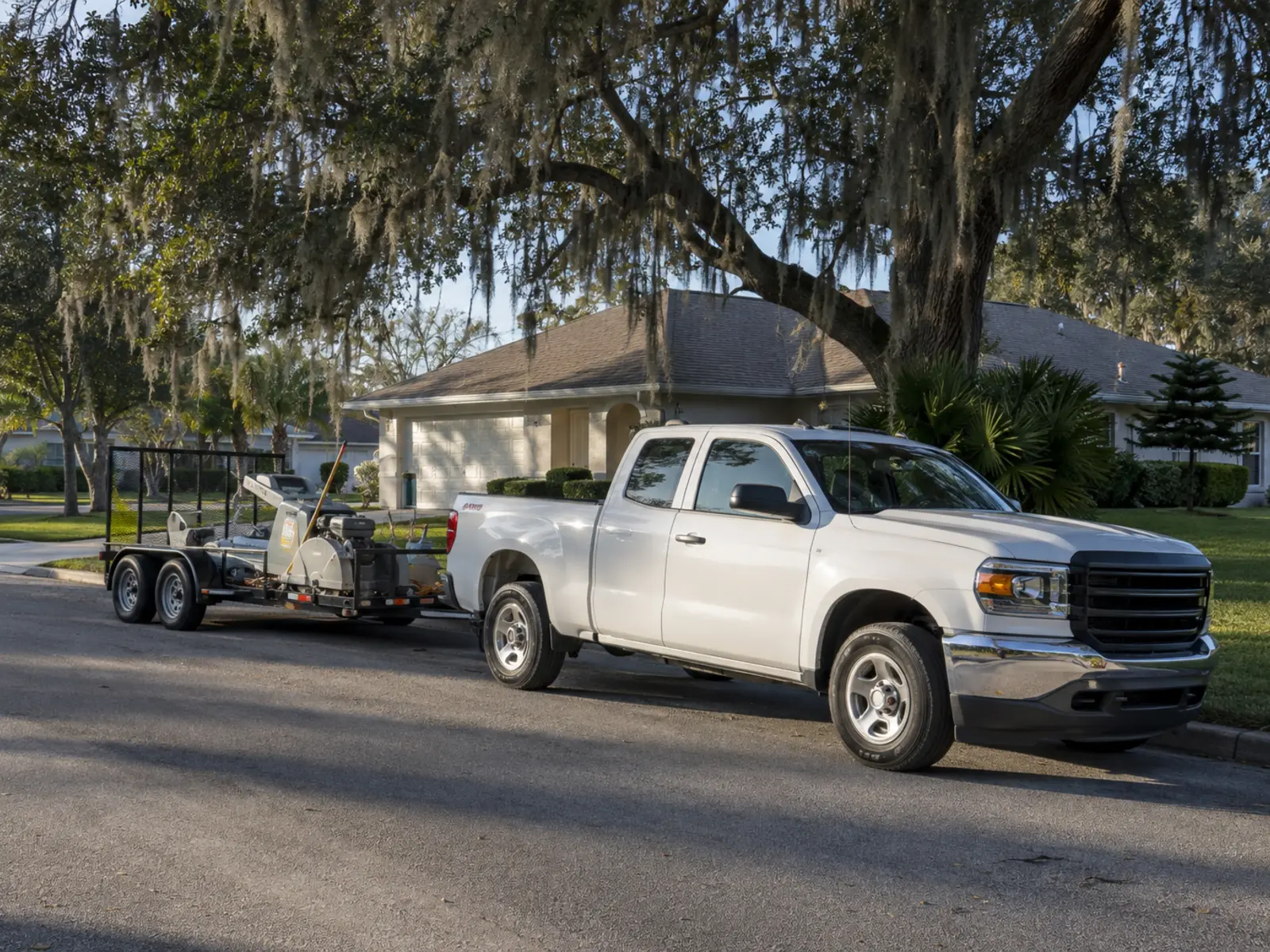
We will sound the slab and tell you whether a resurfacing will fix it. If it will not, we will say that too.
863-734-6623