
At a Joint or Crack
Water has been getting through and washing base material out from underneath.
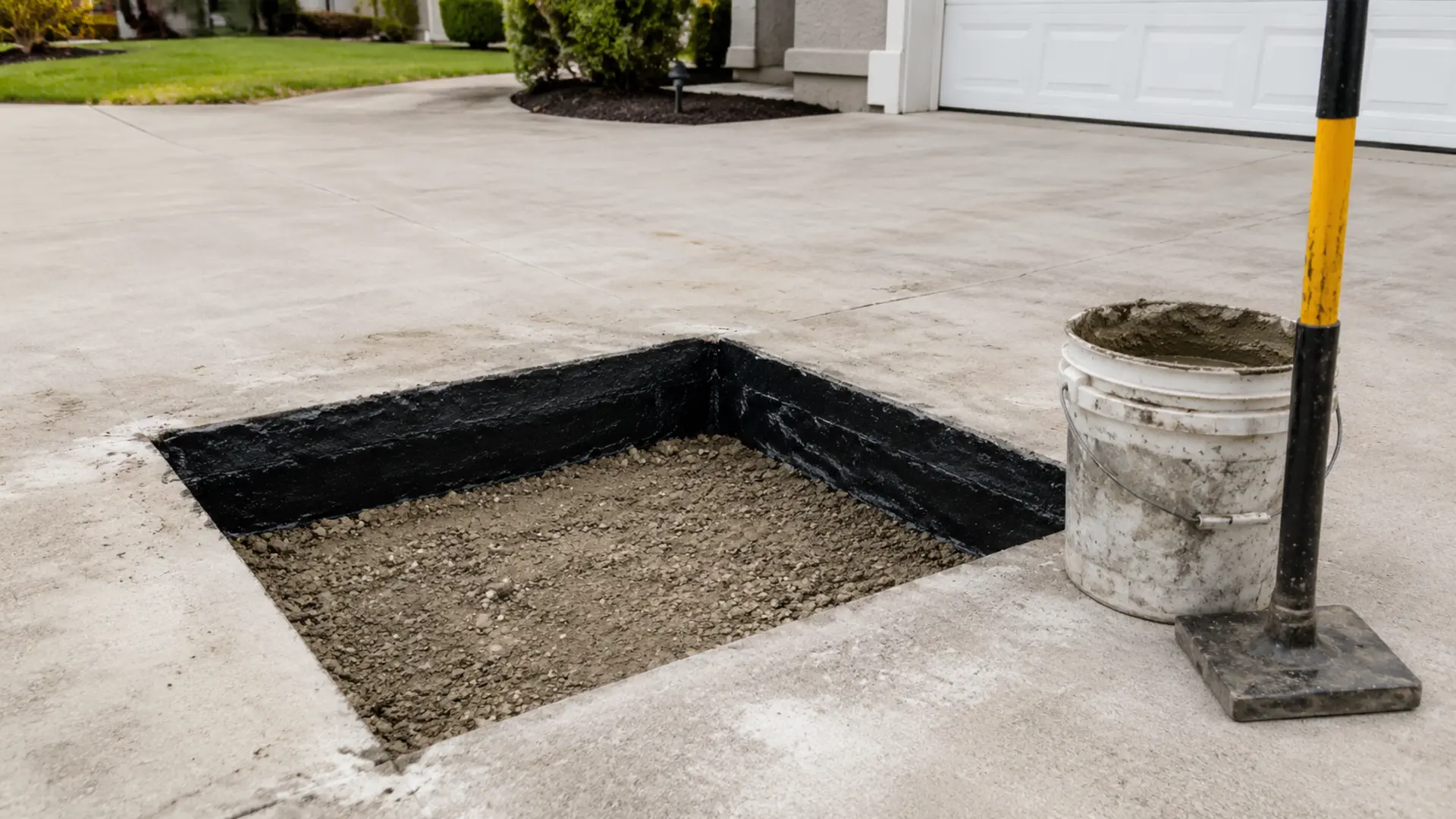
Lakeland Concrete Driveway Experts carry out deep structural pothole patching on concrete driveways across Lakeland and Polk County. Our reputation rests on delivering every job we take on, using rapid-set structural concrete where access matters, building to meet or exceed code and best practice, and closing the cause rather than just filling the hole.
A pothole in concrete is different from one in asphalt, and no two are the same. Concrete does not rut or deform, it fails at a point where something underneath gave way, which means what you can see is always smaller than the actual failure. We have opened up holes at unsealed joints where water had been washing sand out for years, patched wheel paths where a weak surface layer finally broke through, and traced lines of holes back to a buried service trench. Below covers what the hole is telling you, how a patch is built to last, closing the water path, and when patching stops being worth it.
The location and shape of a concrete driveway pothole usually point straight at the cause. A hole at a joint or crack means water has been washing base material out from underneath. One in the wheel path means a weak surface layer that traffic finally broke through. Several along a line means a buried trench below.
Water has been getting through and washing base material out from underneath.
A weak surface layer that traffic has finally broken through.
Heavy vehicle loading at the most vulnerable point of the whole slab.
A buried trench or service run below that was never compacted properly.
The void extends well beyond the visible failure and the patch must too.
Corroding reinforcement expanding and spalling the concrete from within.
Geometry does more for the life of a concrete driveway pothole patch than the material choice does. Filler poured into a bowl-shaped hole tapers to nothing at the edges, where there is almost no bond area and no mechanical key, and traffic lifts it within a season. Every patch is squared out to vertical faces first.
Saw cut or chipped to a clean edge at least two inches deep, never feathered.
Broken concrete and washed-out material removed until solid bearing is reached.
Replacement fill placed and compacted so the patch bears rather than bridges.
Applied to all cut surfaces immediately before the concrete goes in.
Deep patches built up rather than dumped, so there are no voids inside.
Reinforcement where the patch is large enough to need tensile capacity.
Closing the water path is the half of the pothole repair that stops it recurring three feet away. Nearly every concrete driveway pothole here is a water story: a crack or unsealed joint lets water through, the sand beneath carries away, a void grows and the unsupported slab breaks under a wheel.
Unsealed control joints are the most common entry point for water on a Florida slab.
Any crack feeding water under the slab gets treated at the same visit.
Roof water discharging at the slab edge moves a lot of sand over a few years.
A slow leak under a driveway is a common and invisible cause of undermining.
Where the surface directs water to the failure point rather than away from it.
The joint at the street, where movement and traffic combine to open a gap.
These are the materials and geometry for a structural concrete driveway pothole repair. Worth noting: the excavation nearly always ends up larger than the visible hole, because unsound concrete around the perimeter has to come out or the patch edge fails first.
Most single potholes are a half-day job with rapid-set materials.
We tap around the hole to find the true extent of unsound concrete, which is always larger.
The perimeter cut to vertical faces at least two inches deep for proper bond area.
Broken concrete and washed-out base removed until solid material is reached.
Replacement fill placed and compacted so the patch bears on ground, not on a void.
Bonding agent on every face, then structural concrete placed in lifts and tamped.
Texture hand matched, then the crack or joint that let water in is sealed.
Concrete driveway pothole patching stops being worth it at an identifiable point. One or two holes at clear failure points are repairs. Holes appearing in several places across the slab say the base has failed broadly or the concrete has reached the end of its life, and patching becomes a recurring cost with no end.
A well-built structural patch on a sound slab lasts for years and is excellent value. What changes the picture is the pattern. One or two holes at identifiable failure points are repairs. Holes appearing in several places across the slab say something broader has gone, the base has failed generally, or the concrete itself has reached the end of its life, and patching becomes a recurring cost with no end point.
Straight answers, including the ones that talk you out of spending money.
Because the concrete around a pothole is nearly always unsound before it visibly breaks. Sounding reveals delaminated material well beyond the hole, and leaving it means the patch perimeter fails within a season. It is where solid concrete starts, not an upsell.
Four to six hours with a rapid-setting 5,000 PSI structural mix, which is what we use where the driveway is the only access. Standard mixes need twenty-four to seventy-two hours but give a slightly better long-term result and cost less.
Close but not identical, and the gap narrows over time rather than closing. Rapid-setting materials in particular cure lighter and greyer. On a broom finish the texture match matters more than colour for how noticeable it is, and we hand-finish to match.
Close the water paths. Sealing control joints and cracks stops water getting under the slab and washing base material away, which is the mechanism behind nearly every concrete pothole here. Check that downspouts and irrigation are not discharging at the driveway edge.
When holes appear in several places rather than at one identifiable failure point. That pattern means the base has failed broadly or the concrete is at the end of its life, and patching becomes an ongoing expense. We will tell you when you have reached it.

We excavate to sound material, rebuild the base and close the water path that caused it in the first place.
863-734-6623