
One or Two Panels Settled
The rest of the driveway is level and sound, so only the failed sections come out.
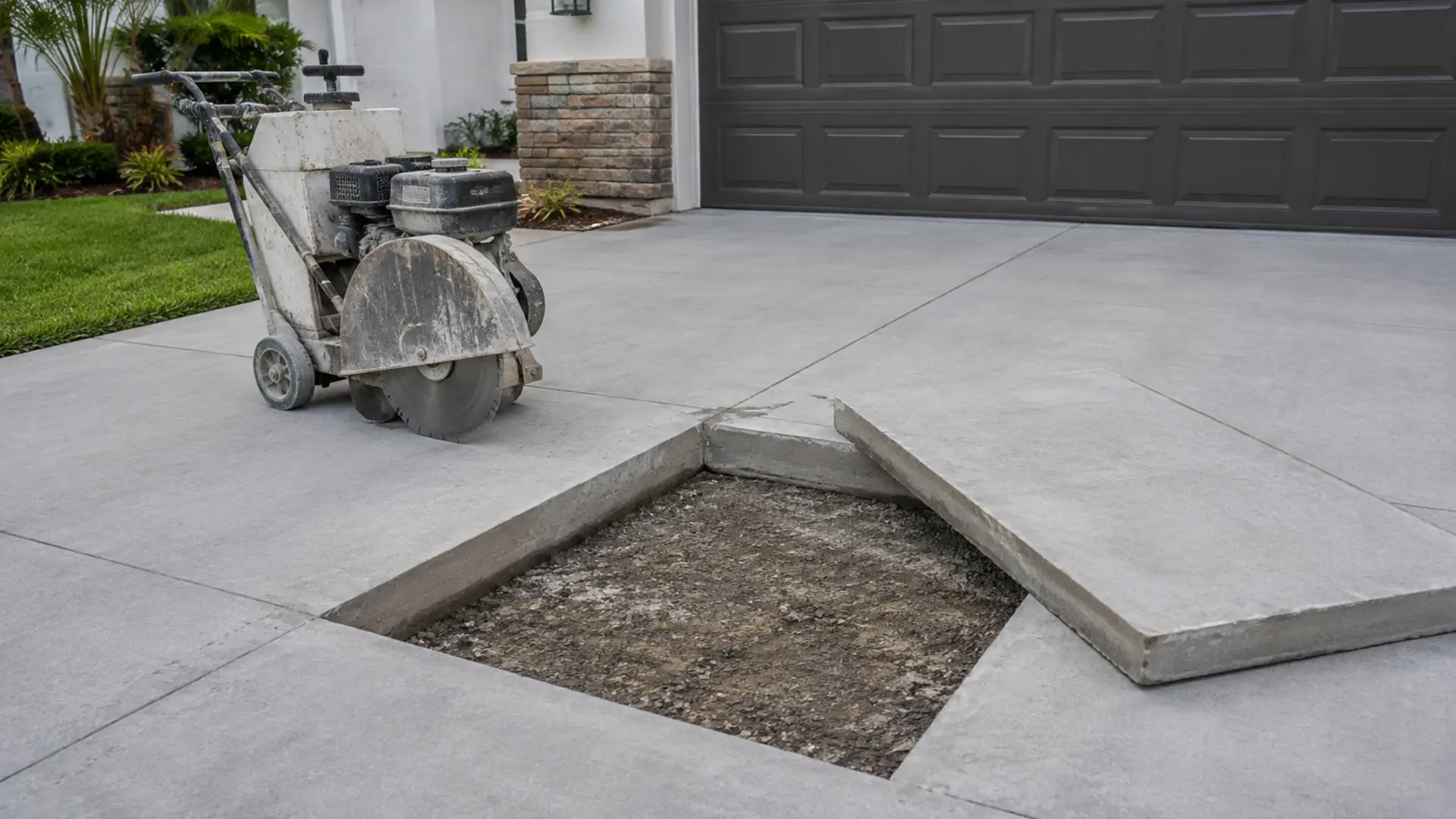
Lakeland Concrete Driveway Experts carry out targeted concrete driveway slab replacement for homeowners across Lakeland and Polk County. We have earned our reputation by delivering on every job we take on, using the best materials for the repair, building to meet or exceed Florida Building Code and local requirements, and recommending the smallest job that genuinely fixes the problem.
Panel replacement cannot be templated because the reason each panel failed is different, and that reason has to be dealt with while the ground is open. We have cut out sections dropped into consolidated organic pockets, panels broken by a utility trench nobody compacted, and slabs lifted by live oak roots where a barrier had to go in before anything was repoured. Below covers when panel replacement is the right approach, fixing the sub-grade underneath, making the new panel sit right, and the point at which replacing the whole driveway is better value.
Concrete driveway slab replacement sits between a repair and a full tear-out, with a fairly clear boundary either side. One or two panels settled while the rest is level, a single panel cracked into pieces with sound neighbours, or a section broken by a utility trench are all candidates. Beyond about a third of the driveway, full replacement is better value.
The rest of the driveway is level and sound, so only the failed sections come out.
Too broken to lift, but the neighbouring slabs are intact and worth keeping.
A section broken for a service run and never properly rebuilt afterwards.
Surface damage too deep and widespread for a patch but confined to one area.
Void beneath, and the concrete itself is fractured rather than merely dropped.
At that point full replacement usually gives better value and a uniform result.
Fixing the sub-grade is the only reason slab replacement outperforms simply lifting the panel. The panel is rarely the actual problem, it dropped because a void, an organic pocket, a poorly compacted trench or a removed tree root gave way beneath it. With the panel out, that ground is accessible for the only time in the driveway's life.
With the panel out, the sub-grade can be seen and rebuilt rather than injected into.
Void, organic pocket, trench backfill or root cavity all point to different remedies.
Removed entirely rather than compacted in place and hoped for.
Limerock placed in lifts and compacted in lifts to a 95% Modified Proctor target, tested not assumed.
Downspouts, irrigation and joint sealant that caused the wash-out get dealt with.
The new panel poured to a correct cross-slope even if the original one was wrong.
These are the details that stop a replaced driveway slab looking like a repair. Cutting on existing joint lines keeps the new panel inside the original grid, full-depth straight cuts give square vertical faces rather than a fractured break-out edge, and the texture is hand-matched to the panels either side.
So the new panel sits in the original grid rather than creating an arbitrary joint.
Square vertical faces on every side, not a fractured break-out edge.
Where the boundary is not an existing joint, dowels transfer load across it.
New panel poured to the same thickness and strength as the surrounding slab.
Broom direction and coarseness matched by hand to the adjacent panels.
Original joint lines re-established and sealed so water cannot get back under.
This is how a targeted concrete driveway slab replacement is carried out. The key line is the removal boundary: cutting on an existing control joint means the new panel is separated by a genuine joint rather than a bonded scar, which is exactly how the driveway was designed to move.
Most single concrete driveway slab panel replacements are a one to two day job, and the rest of the driveway usually stays in service throughout. The step that determines the result is what happens after the panel is lifted out and before anything is poured back.
Limits placed on existing control joints where possible so the new panel fits the grid.
A diamond blade cuts the full slab thickness on straight lines, leaving square faces.
Panel lifted out without disturbing neighbours, material hauled to recycling.
Exposed sub-grade examined, soft material removed, limerock placed and compacted.
Dowels drilled and epoxy set where the boundary is not an existing joint.
Concrete matched to depth and mix, hand finished to texture, joint lines re-cut and sealed.
There are two honest limitations to concrete driveway slab replacement done panel by panel. The colour will not match at first and never fully catches up, and beyond roughly a third of the driveway the arithmetic shifts in favour of replacing the whole thing.
The colour will not match, and it will be obvious at first. New concrete cures considerably lighter than a panel weathered for fifteen years, and it takes several seasons to move toward the surrounding tone without ever fully arriving. On a broom finish the texture match matters more than colour for how noticeable it ends up, and we hand-match the striations, but nobody should expect it to disappear.
Straight answers, including the ones that talk you out of spending money.
Yes, initially and noticeably. New concrete cures much lighter than a panel weathered for years and takes several seasons to move toward the surrounding colour without matching exactly. If uniformity matters, staining or resurfacing the whole driveway afterwards is the way to get it.
Because that is how the driveway was designed to behave. Control joints are the planned boundaries between panels, so cutting there gives a genuine structural break and lets the new panel move independently. Cutting mid-panel creates an arbitrary joint that has to be dowelled and sealed as a special case.
Roughly a third of the driveway. Beyond that the mobilisation, repeated cutting and multiple mismatched panels outweigh the saving, and a full replacement gives a uniform surface with corrected sub-grade for not much more.
Yes, and the root has to be dealt with at the same time. If the tree stays, the roots will lift the new panel too, so the options are a root barrier at depth, a thicker slab in that bay, or accepting recurrence. We would rather discuss that before pouring.
Much less than a full replacement. One or two panels are typically cut, removed, rebuilt and poured within one to two days, and the rest of the driveway usually stays in service. The new panel needs seven days before vehicles cross it.
We will cut out and rebuild just the panels that have gone, and fix the ground underneath while it is open.
863-734-6623